Nhấn Enter để lưu • Esc để huỷ
Candidate: IELTS TEST TAKER
Kích Cỡ Chữ

Listening to the Ocean

Exercise 1 - Definition Matching
Nối các từ vựng bên phải với định nghĩa tiếng Anh tương ứng (A, B, C...) ở cột bên trái.
A. A scientist who studies long-term weather patterns and climate systems
B. A device used to measure the amount of rainfall
C. The number of times a wave vibrates or repeats within a specific time period
D. The amount of heat a substance can absorb before its temperature rises significantly
E. An instrument used to detect and record underwater sounds
F. A space that contains no air or matter
G. The process of sending signals, sound, or information from one place to another
H. The concentration of salt in water
I. A layer in the ocean where sound waves travel efficiently over long distances
J. Methods that use sound waves to measure, detect, or analyse objects
1. Vacuum [n] – chân không
2. Transmit [v] – truyền (âm thanh, tín hiệu)
3. Frequency [n] – tần số
4. Salinity [n] – độ mặn
5. Deep sound channel [n phr] – kênh âm thanh sâu (dưới nước)
6. Hydrophone [n] – máy ghi âm dưới nước
7. Heat capacity [n phr] – nhiệt dung
8. Acoustic techniques [n phr] – kỹ thuật âm thanh
9. Rain gauge [n] – dụng cụ đo lượng mưa
10. Climatologist [n] – nhà khí hậu học
Exercise 2 - Sentence Completion
Quan sát danh sách từ vựng bên trái và gõ từ thích hợp vào chỗ trống trong từng câu bên phải.
Vocabulary List:
penetrate [v] – xuyên qua
pressure [n] – áp suất
track [v] – theo dõi
scatter [v] – tán xạ, phân tán
processing center [n] – trung tâm xử lý dữ liệu
absorb [v] – hấp thụ
submerged [adj/v] – bị chìm dưới nước
distinguish [v] – phân biệt
indicator [n] – chỉ số, dấu hiệu
elusive [adj] – khó nắm bắt, khó quan sát
1. Scientists use satellites to [track] the movement of hurricanes across the ocean.
2. Light can [penetrate] through transparent materials like glass.
3. The submarine remained [submerged] beneath the surface for hours.
4. Plants [absorb] carbon dioxide during photosynthesis.
5. Deep-sea creatures must withstand extreme water [pressure].
6. The data is sent directly to a central [processing center] for analysis.
7. It is difficult to [distinguish] between the two species because they look similar.
8. The particles tend to [scatter] in all directions after the explosion.
9. The rare animal is so [elusive] that researchers have only seen it once.
10. A sudden drop in temperature can be an early [indicator] of climate change.
Exercise 3 - Paraphrasing
Chọn câu diễn đạt tương đương (Paraphrase A, B, C...) ở cột bên phải tương ứng với từng câu gốc bên trái.
1. The oceans cover more than 70 percent of the planet's surface, yet until quite recently, we knew less about their depths than about the surface of the Moon.
2. Water is an excellent medium for sound, transmitting it almost five times faster than its speed in air.
3. Low-frequency sound waves can travel great distances in the deep sound channel with minimal loss of signal.
4. Using SOSUS, scientists are able to track multiple whales at the same time.
5. The ocean plays a significant role in controlling air temperature by storing heat.
6. The system allows scientists to measure rainfall by listening to the sound of raindrops underwater.
7. Colladon and Sturm measured the speed of sound in water using a submerged bell in 1826.
8. Whales in different regions of the Pacific Ocean have distinct calls.
A. Scientists can monitor more than one whale simultaneously thanks to SOSUS.
B. The ocean stores heat, which heavily influences the temperature of the atmosphere.
C. Colladon and Sturm calculated the speed at which sound travels in water by using a bell beneath the surface in 1826.
D. Before recent advancements, we knew more about the Moon than the depths of the oceans, which cover over 70% of the Earth.
E. Sound travels much more quickly in water, moving almost five times faster than it does in the air.
F. By analyzing underwater sounds, scientists can estimate rainfall over the ocean.
G. In different parts of the Pacific, whales make unique sounds.
H. In the deep sound channel, low-frequency sound waves can move across large distances with little signal degradation.
Exercise 3 - Sentence Rewriting
Dựa vào câu gốc và gợi ý, hãy viết lại câu hoàn chỉnh bằng tiếng Anh vào ô bên dưới.
1. turn out that [v phrase] – hóa ra là → Sau nhiều năm nghiên cứu, hóa ra là loài cá này có thể giao tiếp bằng những âm thanh rất phức tạp.
2. be fascinated by [v phrase] – bị cuốn hút bởi → Nhiều nhà khoa học bị cuốn hút bởi khả năng định hướng chính xác của các loài động vật biển.
3. set off an underwater explosion [v phrase] – kích nổ một vụ nổ dưới nước → Nhóm nghiên cứu đã kích nổ một vụ nổ dưới nước để kiểm tra phản ứng của các loài cá gần đó.
4. be placed correctly [v phrase] – được đặt đúng vị trí → Các thiết bị ghi âm phải được đặt đúng vị trí để thu được âm thanh rõ ràng từ dưới đáy biển.
5. be connected by cables to [v phrase] – được nối bằng dây cáp đến → Những máy quay dưới nước được nối bằng dây cáp đến một trạm quan sát trên bờ.
6. be tracked briefly in the wild [v phrase] – được theo dõi trong tự nhiên trong thời gian ngắn → Một số cá thể đã được theo dõi trong tự nhiên trong thời gian ngắn trước khi được thả trở lại biển.
7. distinguish between [v phrase] – phân biệt giữa → Các nhà nghiên cứu cần phân biệt giữa những âm thanh tự nhiên và tín hiệu do động vật tạo ra.
8. be a function of [v phrase] – phụ thuộc vào / là hàm số của → Mức độ âm thanh mà loài cá tạo ra có thể phụ thuộc vào kích thước và môi trường sống của nó.
9. be pieced together into [v phrase] – được ghép lại thành → Hàng nghìn bản ghi âm nhỏ đã được ghép lại thành một bức tranh hoàn chỉnh hơn về đời sống dưới biển.
10. range from... to... [v phrase] – dao động từ... đến... → Độ sâu của các khu vực nghiên cứu dao động từ 20 mét đến hơn 200 mét.

Boring buildings

Exercise 1 - Definition Matching
Nối các từ vựng bên phải với định nghĩa tiếng Anh tương ứng (A, B, C...) ở cột bên trái.
A. A large open central hall inside a building, often extending several floors
B. Lacking strong flavour, character, or interest
C. A situation of confusion, disorder, or emotional disturbance
D. The quality concerned with beauty and artistic taste
E. A loud mixture of unpleasant or clashing sounds
F. Focused mainly on possessions and physical wealth
G. Goods valued mainly for the experience they provide rather than for ownership
H. Formed as a single large block; uniform and lacking variety
I. A slanted moving staircase connecting different levels in a building
J. A state of heightened emotional or physical excitement
1. Bland [adj] – nhạt nhẽo, vô vị
2. Arousal [n] – sự kích thích (cảm xúc hoặc sinh lý)
3. Monolithic [adj] – một khối lớn, đơn điệu
4. Turmoil [n] – sự hỗn loạn, rối loạn
5. Materialistic [adj] – thiên về vật chất
6. Experiential goods [n phr] – trải nghiệm (dạng sản phẩm phi vật chất)
7. Aesthetics [n] – tính thẩm mỹ
8. Cacophony [n] – sự hỗn loạn (âm thanh hoặc hình ảnh)
9. Atrium [n] – sảnh lớn thông tầng trong tòa nhà
10. Diagonal escalator [n phr] – thang cuốn chéo
Exercise 2 - Sentence Completion
Quan sát danh sách từ vựng bên trái và gõ từ thích hợp vào chỗ trống trong từng câu bên phải.
Vocabulary List:
cognitively disengaged [adj] – không còn chú ý về mặt nhận thức
pro-social behavior [n] – hành vi vì lợi ích xã hội, thân thiện
cityscape [n] – cảnh quan đô thị
disorientation [n] – sự mất phương hướng
awe-inspiring [adj] – gây ấn tượng mạnh, gây kinh ngạc
pristine [adj] – nguyên sơ, sạch sẽ hoàn hảo
barraged with information [phr] – bị tấn công dồn dập bởi thông tin
skyscraper [n] – nhà chọc trời
facade [n] – mặt tiền (của tòa nhà)
triangular pattern [n] – mô hình hình tam giác
1. Tourists were impressed by the modern [cityscape] filled with glass towers and busy streets.
2. The ancient temple remains in [pristine] condition despite its age.
3. The mountain view was truly [awe-inspiring] and left visitors speechless.
4. After walking in circles for hours, he experienced a sense of [disorientation].
5. The building’s glass [facade] reflects the sunlight beautifully.
6. In crowded cities, people are often [cognitively disengaged] through constant exposure to screens.
7. Children who display [pro-social behavior] tend to help others voluntarily.
8. The architect designed the roof in a unique [triangular pattern] for better stability.
9. In today’s digital world, we are constantly [barraged with information] from social media and news outlets.
10. The tallest [skyscraper] in the city dominates the skyline.
Exercise 3 - Paraphrasing
Chọn câu diễn đạt tương đương (Paraphrase A, B, C...) ở cột bên phải tương ứng với từng câu gốc bên trái.
1. Research suggests that dull architecture can harm people’s emotional well-being.
2. Ellard measured people’s physiological reactions while walking through different city areas.
3. A plain commercial building reduced people’s excitement levels.
4. Humans are naturally attracted to environments that contain complexity and stimulation.
5. Experiences of awe can influence people’s attitudes and decisions.
6. Attractive streets are not always the most satisfying places.
7. Untidy, active streets encouraged greater helpfulness among pedestrians.
8. Architecture should balance excitement with avoiding sensory overload.
9. The Whole Foods building lacked visual interest compared to its surroundings.
10. Hearst Tower demonstrates how modern design can positively affect city dwellers.
A. A neuroscientist used sensors to monitor emotional arousal while participants walked through contrasting urban blocks.
B. Visually impressive experiences can make individuals more patient and less focused on possessions.
C. Pedestrians were significantly more willing to assist strangers in areas with lively and irregular façades.
D. Overly simple and repetitive buildings may lead to boredom and cognitive disengagement.
E. People function better in intricate surroundings rather than in large, featureless office spaces.
F. A massive blank façade caused a noticeable drop in emotional stimulation among observers.
G. Successful design involves creating excitement without overwhelming people with excessive stimuli.
H. A modern skyscraper combining old and futuristic elements energizes commuters and office workers.
I. A supermarket structure inserted into a textured neighborhood failed to generate engagement.
J. Places that appear neat and pleasant are not necessarily those that generate the greatest happiness.
Exercise 3 - Sentence Rewriting
Dựa vào câu gốc và gợi ý, hãy viết lại câu hoàn chỉnh bằng tiếng Anh vào ô bên dưới.
1. take a physical and mental toll on [v phrase] – gây ảnh ảnh hưởng tiêu cực đến thể chất và tinh thần của → Việc làm việc quá nhiều giờ liên tục có thể gây ảnh hưởng tiêu cực đến thể chất và tinh thần của nhân viên.
2. function best in [v phrase] – hoạt động tốt nhất trong môi trường nào đó → Con người thường hoạt động tốt nhất trong một môi trường yên tĩnh, ổn định và ít bị gián đoạn.
3. be plopped into [phr v] – bị đặt vào một cách đột ngột / không phù hợp trong → Khi bị đặt vào một môi trường hoàn toàn xa lạ một cách đột ngột, trẻ nhỏ có thể cảm thấy lo lắng và mất phương hướng.
4. be a response to [v phrase] – là phản ứng đối với → Nhiều hành vi căng thẳng thực chất là phản ứng đối với những thay đổi bất ngờ trong cuộc sống.
5. produce some kind of novelty [v phrase] – tạo ra một dạng mới mẻ nào đó → Các nhà thiết kế thường cố gắng tạo ra một dạng mới mẻ nào đó để thu hút sự chú ý của khách hàng.
6. overload one’s faculties with [v phrase] – làm quá tải khả năng nhận thức của ai đó bằng → Việc cung cấp quá nhiều thông tin trong một thời gian ngắn có thể làm quá tải khả năng nhận thức của học sinh.
7. be programmed to respond to [v phrase] – được lập trình sẵn để phản ứng với → Con người dường như được lập trình sẵn để phản ứng với những âm thanh lớn và những chuyển động đột ngột.
8. be linked with greater satisfaction [v phrase] – có liên hệ với mức độ hài lòng cao hơn → Việc có quyền tự đưa ra quyết định tại nơi làm việc thường có liên hệ với mức độ hài lòng cao hơn của nhân viên.
9. focus too narrowly on [v phrase] – tập trung quá hẹp vào → Các công ty không nên tập trung quá hẹp vào lợi nhuận mà bỏ qua sức khỏe của người lao động.
10. jolt someone from [v phrase] – làm ai giật mình / kéo ai ra khỏi trạng thái quen thuộc → Một trải nghiệm mới có thể kéo con người ra khỏi thói quen hằng ngày và khiến họ nhìn nhận vấn đề theo cách khác.

Marketing and the Information Age

Exercise 1 - Definition Matching
Nối các từ vựng bên phải với định nghĩa tiếng Anh tương ứng (A, B, C...) ở cột bên trái.
A. A structured system used to collect, analyse, and distribute marketing data
B. The total value of goods and services produced within a country over a specific period
C. The combination or merging of different elements into a unified whole
D. An advantage that allows a company to outperform its competitors
E. Individuals or companies that buy products to sell them again
F. The way people understand or interpret something
G. Relating to a society that has moved beyond manufacturing to a service-based economy
H. Information gathered about markets and competitors to support decision-making
I. Having good judgment and the ability to notice subtle differences
J. A valuable resource that plays a crucial role in achieving long-term goals
1. Perceptions [n] – nhận thức
2. Competitive advantage [n phr] – lợi thế cạnh tranh
3. Convergence [n] – sự hội tụ, sự kết hợp
4. Resellers [n] – người bán lại, nhà phân phối lại
5. Discerning [adj] – sáng suốt, có nhận thức tốt
6. Strategic asset [n phr] – tài sản chiến lược
7. Post-industrial [adj] – hậu công nghiệp
8. Gross Domestic Product (GDP) [n phr] – tổng sản phẩm quốc nội
9. Marketing Intelligence [n phr] – thông tin tình báo tiếp thị
10. Marketing Information System (MIS) [n phr] – hệ thống thông tin tiếp thị
Exercise 2 - Sentence Completion
Quan sát danh sách từ vựng bên trái và gõ từ thích hợp vào chỗ trống trong từng câu bên phải.
Vocabulary List:
evaluate [v] – đánh giá
subordinates [n] – cấp dưới
profitable [adj] – có lợi nhuận
readily [adv] – dễ dàng, sẵn sàng
bombarded with [adj/phr] – bị bủa vây, bị dồn dập
withhold [v] – giấu, giữ lại
retain [v] – giữ lại, duy trì
manipulate [v] – xử lý, thao tác
drown in [v/phr] – ngập trong, chìm trong
accumulate [v] – tích lũy
1. The company managed to remain [profitable] despite fierce competition.
2. Managers should regularly [evaluate] employee performance to improve productivity.
3. She decided to [withhold] important information from the public.
4. Start-ups often struggle to [retain] experienced staff members.
5. With careful planning, small investments can [accumulate] into substantial savings.
6. Employees are constantly [bombarded with] emails and notifications throughout the day.
7. He had to [manipulate] the complex data using advanced software.
8. The new policy was [readily] accepted by most workers.
9. The director held a meeting with his [subordinates] to discuss future strategies.
10. After the flood, the town seemed to [drown in] mud and debris.
Exercise 3 - Paraphrasing
Chọn câu diễn đạt tương đương (Paraphrase A, B, C...) ở cột bên phải tương ứng với từng câu gốc bên trái.
1. Modern marketing emphasizes long-term customer relationships rather than single transactions.
2. Marketing researchers and practitioners collaborate more closely in the information era.
3. Technological advances allow companies to communicate with customers in personalised ways.
4. Marketing information systems rely heavily on computer technology.
5. Information is increasingly viewed as a strategic business resource.
6. Many developed nations have transitioned into information-based economies.
7. Managers are often overwhelmed by excessive or poorly organised information.
8. Companies are redesigning systems to better serve managers’ information needs.
9. A Marketing Information System (MIS) gathers and distributes relevant data to decision-makers.
10. The value of information depends on whether its benefits outweigh its costs.
A. Investing in further research is not sensible when the additional profit gained is minimal compared to the cost.
B. Data has evolved into a key competitive resource that influences corporate strategy.
C. Businesses are examining what decision-makers truly require and building systems around those demands.
D. In today’s technology-driven environment, marketing scholars and practitioners cooperate more than ever before.
E. Many wealthy countries now generate most of their output from service-based and knowledge industries.
F. Companies aim to ensure consumers repeatedly return by maintaining perceived value over time.
G. Computer-based platforms are central to collecting, analysing and presenting marketing data.
H. Senior executives frequently feel buried under large volumes of scattered or unhelpful data.
I. Systems combining staff, procedures and technology deliver accurate information to marketing leaders at the right moment.
J. Digital tools such as customised alerts and messages allow firms to reach specific audiences directly.
Exercise 3 - Sentence Rewriting
Dựa vào câu gốc và gợi ý, hãy viết lại câu hoàn chỉnh bằng tiếng Anh vào ô bên dưới.
1. gain and retain perceptions of value [v phrase] – hình thành và duy trì nhận thức về giá trị → Các công ty cần hiểu cách khách hàng hình thành và duy trì nhận thức về giá trị của một sản phẩm.
2. be tested [v phrase] – được thử nghiệm → Trước khi được bán rộng rãi, sản phẩm mới này cần được thử nghiệm với một nhóm khách hàng nhỏ.
3. lie in doing something [v phrase] – nằm ở việc làm gì → Thành công của một chiến dịch quảng cáo thường nằm ở việc hiểu rõ nhu cầu thực sự của khách hàng.
4. arrive at solutions [v phrase] – đi đến các giải pháp → Các nhà quản lý cần thảo luận kỹ lưỡng để đi đến các giải pháp phù hợp cho vấn đề này.
5. at almost every turn [adv phrase] – gần như ở mọi giai đoạn / mọi lúc → Trong thế giới hiện đại, người tiêu dùng gặp quảng cáo gần như ở mọi nơi họ đến.
6. respond to different products and advertising campaigns [v phrase] – phản ứng với các sản phẩm và chiến dịch quảng cáo khác nhau → Những nhóm khách hàng khác nhau có thể phản ứng rất khác nhau với các sản phẩm và chiến dịch quảng cáo khác nhau.
7. be bombarded with [v phrase] – bị dồn dập bởi / bị quá tải bởi → Mỗi ngày, người tiêu dùng bị dồn dập bởi hàng trăm thông điệp quảng cáo trên mạng xã hội.
8. withhold information [v phrase] – giữ lại, không cung cấp thông tin → Một số công ty có thể giữ lại thông tin quan trọng về sản phẩm để tránh làm khách hàng lo lắng.
9. exceed the returns from [v phrase] – vượt quá lợi ích thu được từ → Chi phí quảng cáo có thể vượt quá lợi ích thu được từ việc bán sản phẩm nếu chiến dịch không được lên kế hoạch tốt.
10. derive its value from [v phrase] – có được giá trị từ → Một thương hiệu thường có được giá trị từ danh tiếng, chất lượng sản phẩm và sự tin tưởng của khách hàng.

READING PASSAGE 1

You should spend about 20 minutes on Questions 1-13, which are based on Reading Passage 1.

Listening to the Ocean

The results of some recent research answer some long-standing questions

A The oceans cover more than 70 percent of the planet's surface, yet until quite recently, we knew less about their depths than about the surface of the Moon. The Moon has been far more accessible for study because astronomers have long been able to observe its surface, first with the naked eye and then with telescopes, both of which focus light. Until the twentieth century, however, no instruments were available for studying Earth's oceans: light, which can travel trillions of kilometers through the vast vacuum of space, cannot penetrate very far in seawater.

B It turns out that for penetrating water, the best instrument is sound. Curious investigators have long been fascinated by sound and how it travels in water. As early as 1490, the artist and scientist Leonardo da Vinci observed, "If you cause your ship to stop and place the head of a long tube in the water and place the outer extremity to your ear, you will hear ships at a great distance from you." It was not until 1826 that two scientists, Colladon and Sturm, accurately measured the speed of sound in water. Using a long tube to listen underwater (as da Vinci had suggested), they recorded how fast the sound of a submerged bell traveled across Lake Geneva in Switzerland. What these investigators demonstrated was that water is an excellent medium for sound, transmitting it almost five times faster than its speed in air.

C Several factors influence how far sound travels underwater and how long it lasts, including particles, salinity, temperature, and pressure. Particles in seawater can reflect, scatter, and absorb certain frequencies of sound, just as certain wavelengths of light may be reflected, scattered, and absorbed by specific types of particles in the atmosphere. In 1943, Maurice Ewing and J.L. Worzel conducted an experiment to test the theory that low-frequency waves, which are less vulnerable than higher frequencies to scattering and absorption, should be able to travel great distances if the sound source is placed correctly. The researchers set off an underwater explosion and learned that it was detected easily by receivers 3,200 kilometers away. In analyzing the results of this test, they discovered a phenomenon known as the "deep sound channel." Sound introduced into this channel of water could travel thousands of kilometers with minimal loss of signal.

D The US Navy quickly recognized the usefulness of low-frequency sound and the deep sound channel. They developed the Sound Surveillance System (SOSUS), which involved underwater microphones, called hydrophones, placed on the ocean floor and connected by cables to onshore processing centers. Christopher Clark of Cornell University soon realized that SOSUS could be used to listen to whales. Using an SOSUS receiver in the West Indies, he could hear whales that were 1,770 kilometers away.

E Whales are the largest of Earth's creatures, yet they are also remarkably elusive. Scientists wishing to observe blue whales must wait in their ships for the whales to surface. A few whales have been tracked briefly in the wild in this way, but not over very great distances, and much about them remains unknown. However, by using SOSUS, scientists can track whales and position them on a map. Moreover, they can track not just one whale at a time but many creatures simultaneously. They can also learn to distinguish whale calls; researchers have detected changes in the calls of finback whales as the seasons change and have found that blue whales in different regions of the Pacific Ocean have different calls.

F SOSUS has also proved instrumental in obtaining information crucial to our understanding of climate. The system has enabled researchers to begin making ocean temperature measurements on a global scale—measurements that are key to understanding the workings of heat transfer between the ocean and the atmosphere. The ocean plays an enormous role in determining air temperature; the heat capacity in only the upper few meters of the ocean is thought to be equivalent to all of the heat in the entire atmosphere. For sound waves traveling horizontally in the ocean, speed is largely a function of temperature. Thus, the travel time of a sound wave between two points is a sensitive indicator of the average temperature along its path. Transmitting sound in numerous directions through the deep sound channel can provide scientists with measurements spanning vast areas of the globe. Thousands of sound paths in the ocean can be pieced together into a map of global ocean temperatures, and by repeating measurements along the same paths over time, scientists can track changes in temperature over months or years.

G Researchers are also using other acoustic techniques to monitor climate. Oceanographer Jeff Nystuen, for example, has explored the use of sound to measure rainfall over the ocean. Monitoring changing global rainfall patterns will contribute to understanding major climate changes as well as the weather phenomenon known as El Niño. Since 1985, Nystuen has used hydrophones to listen to rain over the ocean, acoustically measuring not only the rainfall rate but also the type of rainfall, ranging from drizzle to thunderstorms. By using the sound of rain underwater as a "natural" rain gauge, measurements of rainfall over the oceans will become available to climatologists. In this way, modern society continues to benefit from the investigations of those who, like Leonardo da Vinci, pursued answers to some of nature's fundamental questions.
Questions 1-4
Do the following statements agree with the information given in Reading Passage 1? In boxes 1-4 on your answer sheet, write TRUE if the statement agrees with the information FALSE if the statement contradicts the information NOT GIVEN if there is no information on this
1. In the past, it was easier for scientists to study the Moon than the oceans.
2. Techniques for investigating the Moon are the same as techniques for researching the ocean.
3. Measuring temperature changes in the ocean using sound is more time-consuming than other methods
4. Hydrophones can distinguish different kinds of rain.
Questions 5-8
Reading Passage 1 has seven paragraphs, A-G. Which paragraph contains the following information? Write the correct letter, A-G, in boxes 5-8 on your answer sheet. NB You may use any letter more than once.
Paragraphs
A. Paragraph A
B. Paragraph B
C. Paragraph C
D. Paragraph D
E. Paragraph E
F. Paragraph F
G. Paragraph G
5. examples of things that affect the distance sound can travel in water
6. details of the connection between ocean temperatures and climate
7. details of ways in which light and sound are similar
8. reference to a long-term study of different types of weather
Questions 9-13
Choose the correct letter, A, B, C or D. Write the correct letter in boxes 9-13 on your answer sheet.
9. According to the passage, who conducted research into the rate at which sound travels in water?
10. According to the passage, who conducted research into the distances certain types of sound waves travel in water?
11. SOSUS allows whale researchers to
12. Finback whale calls change
13. SOSUS allows scientists

READING PASSAGE 2

You should spend about 20 minutes on Questions 14-26, which are based on Reading Passage 2.

Boring buildings

There could be more than an economic or nostalgic price to impersonal retail and high-rise construction; boring architecture may take an emotional toll on the people forced to live with it.

A A growing body of research in cognitive science illuminates the physical and mental toll bland cityscapes take on residents. Generally, these researchers argue that humans are healthier when they live surrounded by variety or work in well-designed, unique spaces, rather than in unattractive, generic ones. Urban policy professor Justin Hollander and architect Ann Sussman review scientific data to help architects and urban planners understand how exactly people respond to their built surroundings, particularly at work. They argue that people function best in intricate settings, not in "big, blank, boxy offices."

B Indeed, that's what Colin Ellard, a neuroscientist at the University of Waterloo in Canada, has found in his work. Five years ago, Ellard became interested in a certain building—the gigantic Whole Foods Market "plopped into" a notoriously textured part of lower Manhattan in New York. Ellard partnered with the Guggenheim Museum to analyze what happens when someone walks out of a tiny neighborhood restaurant and encounters a full city block with nothing but "the long, blank facade of the Whole Foods Market" building.

C In 2011, Ellard led small groups on Lower East Side walks to measure the effect of the urban environment on them. Participants recorded their responses to questions at each stopping point and wore sensors that measured skin conductance, a response to emotional excitement. Passing the monolithic Whole Foods Market, people's state of arousal plummeted. Physiologically, Ellard explained, they were bored. To describe this place, they used words like "bland" and "passionless." In contrast, one block east at the other test site—a "lively sea of restaurants with lots of open doors and windows"—people measured high levels of excitement and listed words like "lively" and "socializing." Ellard explains that the main objective of urban design should be to produce some kind of novelty or change every few seconds; otherwise, we become cognitively disengaged.

D The trick, it seems, is to design a world that excites but doesn't overload our faculties with a constant barrage of information. "We are, as animals, programmed to respond to thrill," said professor Brendan Walker. In Walker's "thrill laboratory" at the University of Nottingham in the UK, devices measure heart rate and skin conductance to see how people respond to adrenaline-producing experiences, such as a roller-coaster ride. A thrilling encounter moves us quickly from a state of equilibrium to a desirable "disorientation." "Humans want a certain element of turmoil or confusion," he said. "Complexity is thrilling, whether in an amusement park or architecture."

E Psychologists have found that awe-inspiring moments can potentially improve our well-being. One study conducted by Melanie Rudd, Kathleen Vohs, and Jennifer Aaker of Stanford University in the US showed that the feeling of "awe" can make people more patient and less materialistic. In an experiment, the researchers showed students 60-second clips of waterfalls, whales, or astronauts in space. After only a minute of virtual images, those who said they were awed also felt less pressed for time. In another variation, people made hypothetical choices between physical and experiential goods of equal monetary value. Those who had just "felt awe" were more likely to choose an experience over a possession, a choice that is linked with greater satisfaction in the long run. In other words, a visual buzz—whether architectural or natural—might have the ability to change our frame of mind, making modern-day life more satisfying and interactive.

F It's important to note, however, that architectural boredom isn't about how pristine a street is. People often confuse successful architecture with whether an area looks pleasant. On the contrary, when it comes to city buildings, people often focus too narrowly on aesthetics, said Charles Montgomery, author of Happy City: Transforming Our Lives Through Urban Design. Some of the happiest blocks in New York City, he argues, are "kind of ugly and messy."

G In 2014, Montgomery's Happy City Lab conducted an experiment in which he found a strong correlation between messier blocks and pro-social behavior. Montgomery sent researchers, posing as lost tourists, to places he coded as either "active" or "inactive" facades. He concluded that the former had a high level of interest—they were messy—while the latter had no special features, such as long warehouse blocks. Pedestrians at active sites were nearly five times more likely to offer assistance than at inactive ones. Of those who assisted, seven times as many at the active site offered the use of their phone.

H Fortunately, it's not necessarily a dichotomy—new architecture can achieve the optimal level of cacophony and beauty. Take the 2006 Hearst Tower in midtown Manhattan. Designed by architect Norman Foster, Hearst Tower is a glass-and-steel skyscraper, 40 stories of which are designed in a triangular pattern, differing in style from the 1920s Art Deco base. From the outside, the facade jolts city dwellers from their daily commutes, while energizing employees who enter it each morning. For many who walk by, Hearst Tower's design may not be the easiest to understand; it's both sleek and old. The top looks like it traveled from the future. Inside, workers travel upon diagonal escalators, up a three-story water sculpture, through the tower's historic atrium, flooded with light. Few New Yorkers who pass by would find this building boring. And they're likely to be happier—maybe even nicer to each other—because of it.

Questions 14-18
Reading Passage 2 has eight paragraphs, A-H. Which paragraph contains the following information? Write the correct letter, A-H, in boxes 14-18 on your answer sheet.
Paragraphs
A. Paragraph A
B. Paragraph B
C. Paragraph C
D. Paragraph D
E. Paragraph E
F. Paragraph F
G. Paragraph G
H. Paragraph H
14. a description of a building that has a positive effect
15. a reference to architecture affecting people's performance in their jobs
16. examples of the intensity of people's reactions in two urban settings
17. details of a study where seeing certain pictures reduced people's stress
18. a claim about feelings experienced in response to both architecture and leisure settings
Questions 19-23
Look at the following statements (Questions 19-23) and the list of researchers below. Match each statement with the correct researcher, A, B, C or D. Write the correct letter, A, B, C or D, in boxes 19-23 on your answer sheet. NB You may use any letter more than once.
List of Researchers
A. Colin Ellard
B. Brendan Walker
C. Rudd, Vohs and Aaker
D. Charles Montgomery
19. The aim of good city planning is to provide variety in architecture.
20. People in untidy areas were more helpful.
21. People who had recently felt amazed placed less importance on material goods.
22. 'Attractive' places are not necessarily the most enjoyable places to be.
23. One particular building failed to provide visual stimulation.
Questions 24-26
Complete the summary below. Choose ONE WORD ONLY from the passage for each answer. Write your answers in boxes 24-26 on your answer sheet.
Hearst Tower

Norman Foster's Hearst Tower was built in 2006. The 40-storey modern triangular-patterned building is made of glass and steel, contrasting with the base which is in the style of the 1920s. The sight of the building's 24 has a striking impact on commuters and employees. Some passers-by may find the building's design confusing, as it mixes old and new elements. Inside the tower, 25 carry employees up past a large water sculpture in the light-filled 26 .

READING PASSAGE 3

You should spend about 20 minutes on Questions 27-40, which are based on Reading Passage 3.

Marketing and the Information Age

A For the early practitioners of marketing in the late 19th and early 20th centuries, the business of selling was simply a matter of continually finding new customers. By contrast, marketing managers in the current era recognize the importance of gathering information about the market and about potential customers. They understand that if companies are to be profitable, customers must gain and retain their perceptions of value from the brands they buy over a long period, rather than from a single transaction. This also means that customers must see value in continually returning to the stores where they shop, as well as to the service providers they deal with.

B Marketing practitioners and marketing scientists have never worked more closely than they do today. There are many reasons for this, including the fact that we are in the information age, where convergence in telecommunications, media, and technology is challenging old ways and leading to new methods and tools being tested. Customer expectations have risen as new technologies allow for innovative approaches. For instance, the subscriber-TV music channel Channel [V] encourages its viewers to sign up for text messages and email alerts that inform them when their favorite artists and songs are about to be broadcast. Competitive advantage lies in recognizing which customers deserve greater attention, not just because they demand it but because it makes commercial sense to provide high levels of product quality and service.

C Modern marketing information systems rely on information technology to gather, store, and analyze marketing intelligence. While some of the information is gathered by government bodies such as the Australian Bureau of Statistics and Statistics New Zealand, most of it is collected by marketing organizations for client companies. In the process, computer technology is used to manipulate the data and present the information in such a way that executives can readily identify any problems or issues and quickly arrive at solutions.

D In order to produce superior value and satisfaction for customers, marketing managers need information at almost every turn. They need information about customers—end-users and resellers—as well as competitors and governmental and other forces in the marketplace. One marketing executive put it this way: "To manage a business well is to manage its future; and to manage the future is to manage information." Increasingly, marketers are viewing information not just as an input for making better decisions but also as an important strategic asset and marketing tool. As household incomes increase, choices expand, and buyers become more discerning, sellers need information about how buyers respond to different products and advertising campaigns.

E The supply of information has also increased greatly. It has been suggested by futurist and bestselling author John Naisbitt that the United States, and by observation, developed countries such as Australia, New Zealand, and Singapore, are moving from industrial to information-based economies. These post-industrial economies earn 70-80% of their Gross Domestic Product from services and have entered what some commentators have termed the 'Information Age' or the 'Information Technology Era.'

F One study found that, with all the information now available through supermarket scanners, a packaged goods product controller is bombarded with one million to one billion new numbers each week. As Naisbitt points out, "Running out of information is not a problem, but drowning in it is." Yet marketers frequently complain that they lack the right kind of information but have plenty of the wrong kind, or they claim that marketing information is so widely dispersed throughout the organization that it takes great effort to locate even simple facts. In addition, subordinates may withhold information they believe will reflect badly on their performance, and important information often arrives too late to be useful, or on-time information may not be accurate. Therefore, marketing managers need better information. Although marketing organizations have greater capacity to provide managers with information, they often do not use it effectively. As a result, many marketing organizations are now studying their managers' information needs and designing information systems specifically to meet those needs.

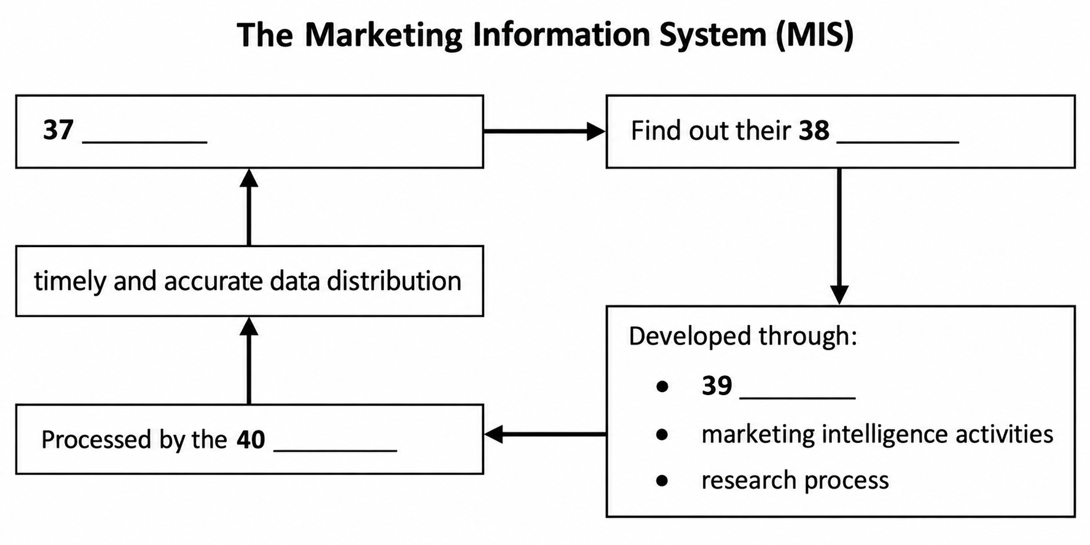
G One solution is to use a Marketing Information System (MIS). This system consists of people, equipment, and procedures that, when integrated, are able to gather, analyze, evaluate, and distribute needed, timely, and accurate information to marketing decision-makers. The MIS begins and ends with marketing managers. First, it interacts with these managers to assess their information needs. Next, it develops the needed information from internal records, marketing intelligence activities, and the research process. The analysis unit processes the data to make it more useful, and finally, the MIS distributes it to managers in the right form and at the right time to help them make better marketing decisions.

H However, the costs of obtaining, processing, storing, and delivering information can quickly accumulate. In some cases, additional information will do little to change or improve a manager's decision, or the costs of the information will exceed the returns from the improved decision. For example, if an organization estimates that launching a new product without further information will yield a profit of $500,000, it would be unwise to spend $30,000 on additional information that would only increase the profit to $525,000. Information, by itself, is valueless; its value comes from its use.

Questions 27-31
Reading Passage 3 has eight paragraphs, A-H. Which paragraph contains the following information? Write the correct letter, A-H, in boxes 27-31 on your answer sheet
Paragraphs
A. Paragraph A
B. Paragraph B
C. Paragraph C
D. Paragraph D
E. Paragraph E
F. Paragraph F
G. Paragraph G
H. Paragraph H
27. the fact that there may be too much information to cope with
28. the relevance of generating repeat business
29. an example of personalised marketing
30. an illustration of a situation where commissioning new information research might not be advisable
31. how the greater wealth of customers enables them to select from a broader range of products
Questions 32-36
Do the following statements agree with the claims of the writer in Reading Passage 3? In boxes 32-36 on your answer sheet, write YES if the statement agrees with the claims of the writer NO if the statement contradicts the claims of the writer NOT GIVEN if it is impossible to say what the writer thinks about this
32. The majority of marketing statistics are gathered by government agencies.
33. The move from an industrial to an information-based economy has happened more quickly in New Zealand than in Australia.
34. Employees sometimes hide information that gives a poor impression of them.
35. Managers frequently fail to make good use of the information they receive.
36. Marketing information has to be used to be valuable.
Questions 37-40
Complete the flow-chart below. Choose NO MORE THAN TWO WORDS from the passage for each answer. Write your answers in boxes 37-40 on your answer sheet.
The Marketing Information System (MIS)
Diagram
37.
38. Find out their
39.
40. Processed by the
Reading – Real Tests Vol 5 – Test 3 – IELTS 7+ Cấp Tốc & Giao tiếp
Thành phần của mẫu đã bị xóa hoặc không khả dụng: header
Thành phần của mẫu đã bị xóa hoặc không khả dụng: footer