Nhấn Enter để lưu • Esc để huỷ
Candidate: IELTS TEST TAKER
Kích Cỡ Chữ

The pesticide-free village

Exercise 1 - Definition Matching
Nối các từ vựng bên phải với định nghĩa tiếng Anh tương ứng (A, B, C...) ở cột bên trái.
A. A loss of quality or condition in the environment, soil, or ecosystem over time
B. The money or resources spent on a project or investment
C. A plant that retains green leaves throughout the year
D. A person or business that buys goods from producers and sells them to retailers or consumers
E. A substance used to kill harmful insects or pests that damage crops
F. Continued progress or driving force that keeps an activity or process moving forward
G. The condition of lacking sufficient money or resources to meet basic needs
H. The total amount of crops produced from a particular area
I. A mixture of different chemical substances or compounds used together for a specific purpose
J. A chemical substance added to soil to help plants grow
1. Pesticide [n] – thuốc trừ sâu
2. Fertiliser [n] – phân bón
3. Middleman [n] – người trung gian, thương lái
4. Yield [n] – sản lượng, năng suất
5. Outlay [n] – chi phí
6. Degradation [n] – sự suy thoái
7. Cocktail [n] – hỗn hợp (thuốc trừ sâu, hóa chất, v.v.)
8. Poverty [n] – sự nghèo đói
9. Evergreen [adj] – thường xanh (cây cối quanh năm có lá)
10. Momentum [n] – đà phát triển, động lực
Exercise 2 - Sentence Completion
Quan sát danh sách từ vựng bên trái và gõ từ thích hợp vào chỗ trống trong từng câu bên phải.
Vocabulary List:
illiterate [adj] – mù chữ
migrate [v] – di cư
decimate [v] – tàn phá, làm giảm mạnh
disseminate [v] – lan tỏa, truyền bá
plague [v] – gây hại, hoành hành
escalate [v] – leo thang, tăng lên
resistant [adj] – có khả năng chống lại (thuốc trừ sâu, bệnh, v.v.)
ecological disaster [n] – thảm họa sinh thái
Non-Government Organisation (NGO) [n] – tổ chức phi chính phủ
organic [adj] – hữu cơ, tự nhiên
1. Farmers are encouraged to switch to methods to protect soil and water quality.
2. The spread of crop diseases can quickly if not controlled early.
3. Locusts continued to the farmlands, destroying all vegetation in their path.
4. Climate change has forced many animal species to in search of cooler habitats.
5. Some insects have become to traditional pesticides, making control efforts more difficult.
6. The oil spill in the ocean is considered one of the worst in recent decades.
7. Several international are working to provide clean water and education in rural areas.
8. Floods and droughts have agricultural production across the region.
9. The campaign aims to information about sustainable farming to local communities.
10. The literacy project helps adults in remote areas to improve their reading and writing skills.
Exercise 3 - Paraphrasing
Chọn câu diễn đạt tương đương (Paraphrase A, B, C...) ở cột bên phải tương ứng với từng câu gốc bên trái.
1. Farmers in Punukula switched from traditional food crops to cotton, attracted by its promise of higher income.
2. Local dealers supplied seeds and chemicals, making farmers dependent on their products and advice.
3. Initially, chemical farming brought high yields, but it soon caused severe environmental damage.
4. Continuous pesticide use led to resistant pests and forced farmers to use more chemicals and fertilisers.
5. As pest resistance grew, production costs rose, pushing farmers into debt and poverty.
6. A village elder’s experiment with Non-Pesticide Management (NPM) using neem started a turning point.
7. Neem provided a natural, affordable alternative to chemical insecticides while also enriching the soil.
8. Farmers quickly saw that NPM produced similar harvests but with higher profits since no chemicals were needed.
9. By 2000, the entire village adopted NPM, and women benefited economically through neem seed collection.
10. Punukula became a pesticide-free model village inspiring other communities to follow its sustainable farming practices.
A. A respected local leader’s trial of non-chemical farming marked the beginning of a dramatic agricultural transformation.
B. Punukula’s dependence on chemical cotton farming eventually trapped farmers in a cycle of high expenses and declining soil health.
C. Village women gained new income opportunities by collecting and selling neem seeds as eco-friendly pest control spread.
D. The shift to cotton farming initially raised incomes but tied Punukula’s farmers to expensive inputs from dealers.
E. Pesticide overuse wiped out natural pest predators, forcing growers to spend more on fertilisers and chemicals as profits disappeared.
F. Neem-based pest control became the foundation of Non-Pesticide Management, providing both crop protection and soil nutrition at low cost.
G. Once the results were clear, the entire community adopted organic pest control, improving both productivity and livelihoods.
H. A booming pesticide trade emerged as middlemen provided credit, seeds, and chemical advice to inexperienced farmers.
I. The success of Punukula’s eco-friendly revolution attracted visitors from other regions hoping to replicate its sustainable practices.
J. Early chemical farming seemed successful, but within years it triggered ecological collapse as resistant pests spread rapidly.

New filter promises clean water for millions

Exercise 1 - Definition Matching
Nối các từ vựng bên phải với định nghĩa tiếng Anh tương ứng (A, B, C...) ở cột bên trái.
A. A legal right granted to an inventor to exclusively produce or sell an invention
B. The process of heating clay or ceramic materials at high temperatures to harden them
C. The quality or texture of a material that is smooth or composed of small particles
D. The natural substances derived from living organisms, often used to enrich soil
E. A hollow space or gap within an object, structure, or body
F. The condition or act of being against the law
G. The process of separating solids from liquids using a porous material
H. A substance such as animal waste used to improve soil fertility
I. A harmful microorganism that can cause disease in plants, animals, or humans
J. An oven or furnace used for baking, drying, or hardening materials such as clay
1. Manure [n] – phân chuồng
2. Kiln [n] – lò nung, lò gốm
3. Pathogen [n] – mầm bệnh, tác nhân gây bệnh
4. Fine (clay) [adj] – mịn (đất sét mịn)
5. Organic material [n] – vật liệu hữu cơ
6. Firing [n] – quá trình nung
7. Filtration [n] – quá trình lọc
8. Cavity [n] – khoang rỗng, lỗ hổng
9. Patent [n] – bằng sáng chế
10. Illegality [n] – tính bất hợp pháp
Exercise 2 - Sentence Completion
Quan sát danh sách từ vựng bên trái và gõ từ thích hợp vào chỗ trống trong từng câu bên phải.
Vocabulary List:
ingenious [adj] – khéo léo, tài tình
porous [adj] – có lỗ nhỏ li ti, thấm nước
universally available [adj] – có sẵn khắp nơi
zero technology [n] – công nghệ đơn giản, không cần thiết bị phức tạp
trap [v] – giữ lại, bẫy
down to earth [adj] – thực tế, giản dị
capitalize on [v] – tận dụng, khai thác
enable [v] – cho phép, giúp làm được điều gì đó
cutting edge [adj] – tiên tiến, hiện đại nhất
exploit [v] – khai thác, lợi dụng
1. The researcher designed an device that converts air moisture into drinking water.
2. The filter is made from a material that allows air to pass through but blocks harmful particles.
3. The new energy system uses methods that require no electricity or advanced machinery.
4. Engineers are trying to renewable resources to provide power for remote areas.
5. This invention represents a breakthrough in sustainable design and clean energy.
6. The cooling mechanism works by hot air and releasing it as cool vapor.
7. The company plans to its strong reputation to attract investors for future projects.
8. Its materials are , making it easy for developing nations to reproduce the design locally.
9. The technology is so that even people in rural areas can apply it without expert help.
10. The new irrigation model will farmers to grow crops efficiently even during dry seasons.
Exercise 3 - Paraphrasing
Chọn câu diễn đạt tương đương (Paraphrase A, B, C...) ở cột bên phải tương ứng với từng câu gốc bên trái.
1. A scientist at ANU developed a low-cost water filter using clay, coffee grounds, and cow manure to provide clean water in developing countries.
2. The idea originated from a project in East Timor, where local clay needed modification to make working ceramic filters.
3. Flynn’s manure-firing technique removed the need for kilns, making the process adaptable anywhere.
4. Unlike commercial filters, Flynn’s design is affordable and easy to make from local materials.
5. Cow manure acts as an efficient, high-temperature fuel that replaces costly kilns and scarce fuels.
6. Clay’s natural porosity, once seen as a flaw by potters, became a key advantage in the filtering process.
7. The filters work because they allow water to pass through but block harmful bacteria like E-coli.
8. Organic materials burn away leaving cavities that improve filtration and prevent cracks.
9. Since all materials are widely available, Flynn chose not to patent his invention so it could be freely used worldwide.
10. The technology has the potential to bring safe drinking water to people across the developing world.
A. The filters’ effectiveness relies on pores that let water flow through while trapping dangerous microorganisms.
B. Flynn’s low-tech water filters, made from everyday materials, could help deliver safe drinking water to poor regions.
C. Using dried cow manure as fuel replaces the need for costly kilns and allows filters to be fired almost anywhere.
D. The technique developed from a project in East Timor, where local clay was too fine and had to be modified with organic matter.
E. Because all materials are accessible globally, Flynn decided not to patent the process so anyone could use it freely.
F. The process uses clay, coffee grounds, and manure, and its creator proved it could remove deadly bacteria from drinking water.
G. As the organic materials burn off, they create a porous structure that captures pathogens and strengthens the clay.
H. Flynn’s firing method allows villagers to make filters without specialized ovens or expensive fuels like wood or gas.
I. Porous clay, once seen as undesirable in pottery, became a crucial feature that made the filters effective.
J. Simple and inexpensive, Flynn’s water filters can be produced locally, unlike commercial models that are too costly for most families.

Putting the brakes on climate change

Exercise 1 - Definition Matching
Nối các từ vựng bên phải với định nghĩa tiếng Anh tương ứng (A, B, C...) ở cột bên trái.
A. The preservation and protection of natural environments and resources
B. The process of cutting down or clearing large areas of forest
C. A gas produced by decomposing organic matter, often contributing to global warming
D. A storage or maintenance facility for vehicles or goods
E. A person or company responsible for delivering parcels or messages
F. A model or sample used to test a new concept or design before mass production
G. The layer of gases surrounding the Earth or another planet
H. A substitute or other possible option that can replace something else
I. A technology that generates electricity from chemical reactions between hydrogen and oxygen
J. The process of capturing and storing carbon dioxide to reduce its release into the atmosphere
1. Conservation [n] – sự bảo tồn
2. Deforestation [n] – nạn phá rừng
3. Alternative [n] – sự thay thế, lựa chọn khác
4. Fuel-cell [n] – pin nhiên liệu
5. Prototype [n] – nguyên mẫu, mẫu thử đầu tiên
6. Methane [n] – khí mê-tan
7. Sequestration [n] – sự cô lập, lưu trữ (carbon dưới lòng đất)
8. Courier [n] – người chuyển phát, công ty giao hàng
9. Depot [n] – kho, trạm xe (nơi cất giữ và bảo dưỡng phương tiện)
10. Atmosphere [n] – khí quyển
Exercise 2 - Sentence Completion
Quan sát danh sách từ vựng bên trái và gõ từ thích hợp vào chỗ trống trong từng câu bên phải.
Vocabulary List:
emission [n] – khí thải
refuelling [n] – việc tiếp nhiên liệu
crucially [adv] – một cách quan trọng, then chốt
distribution [n] – sự phân phối
disrupt [v] – làm gián đoạn, phá vỡ
freak weather [n] – thời tiết bất thường
investment [n] – sự đầu tư
viable [adj] – khả thi, có thể thực hiện được
renewable [adj] – tái tạo được (năng lượng)
generate [v] – tạo ra, phát ra (năng lượng, điện...)
1. Solar and wind power are considered sources that help reduce dependency on fossil fuels.
2. The recent patterns have caused major flooding and damage to infrastructure.
3. New technologies can electricity more efficiently while minimizing waste.
4. Large-scale in clean energy is essential to combat climate change.
5. Power outages can seriously industrial production and city services.
6. The company needs to develop a more effective network to ensure power reaches rural areas.
7. Switching to electric vehicles can significantly reduce carbon in major cities.
8. Regular stations will be necessary to support the expansion of electric transport systems.
9. For renewable projects to be , governments must provide long-term policy support.
10. , innovation in energy storage will determine the success of the green transition.
Exercise 3 - Paraphrasing
Chọn câu diễn đạt tương đương (Paraphrase A, B, C...) ở cột bên phải tương ứng với từng câu gốc bên trái.
1. Climate change caused by vehicle emissions is linked to damage in ecosystems like coral reefs and rainforests.
2. Scientists warn that global temperature increases could devastate ecosystems unless greenhouse gas emissions are reduced.
3. Cutting emissions requires reducing deforestation and replacing fossil fuels with cleaner energy sources.
4. Fuel-cell technology offers the most promising solution for making cars environmentally friendly.
5. Fuel-cells generate electricity using hydrogen and oxygen, emitting only water as a by-product.
6. Although hydrogen can be extracted from water, the process is not eco-friendly if fossil fuels are used to supply electricity.
7. Hydrogen can also be produced from natural gas, but the resulting carbon dioxide must be stored underground.
8. Fuel-cell vehicles, such as buses and vans, are already being tested, but hydrogen refuelling stations are still scarce.
9. Public transport fleets are ideal for early adoption because they operate from centralized depots.
10. More investment in fuel-cell technology is essential to slow climate change and protect biodiversity.
A. Scientists believe switching to clean energy sources and halting deforestation are vital to lowering greenhouse gas emissions.
B. Hydrogen-fuelled vehicles are already in limited use, but the lack of refuelling infrastructure limits their spread.
C. Vehicle pollution contributes heavily to global warming, which disrupts natural environments across the planet.
D. Producing hydrogen from natural gas is possible, but it creates carbon dioxide that must be safely stored underground.
E. Without reducing emissions, rising global temperatures could destroy forests, coral reefs, and many animal habitats.
F. Fuel-cells work like batteries, combining hydrogen and oxygen to create electricity while releasing only water vapour.
G. Climate-friendly transport will depend largely on fuel-cell innovation, which could outperform combustion engines.
H. Powering hydrogen production with fossil fuels undermines its environmental benefits unless renewable energy is used.
I. Fleets of buses and delivery vehicles are suitable for early trials of fuel-cell systems due to their centralized operations.
J. Expanding research and funding for hydrogen fuel-cells is crucial for reducing emissions and preserving ecosystems.

READING PASSAGE 1

You should spend about 20 minutes on Questions 1–13, which are based on Reading Passage 1.

The pesticide-free village

Gerry Marten and Dona Glee Williams report on the Indian village of Punukula, so nearly destroyed by reliance on pesticides

Around 20 years ago, a handful of families migrated from the Guntur district of Andhra Pradesh, south-east India, into Punukula, a community of around 900 people farming plots of between two and ten acres. The outsiders from Guntur brought cotton culture with them, and this attracted resident farmers by promising to bring in more hard cash than the mixed crops they were already growing to eat and sell, such as millet, mung beans, chilli and rice. But growing cotton meant using pesticides and fertilisers — until then a mystery to the mostly illiterate farmers of the community.

Local agrochemical dealers obligingly filled the need for information and supplies. These ‘middlemen’ sold commercial seeds, fertilisers and insecticides on credit, and guaranteed purchase of the crop. They offered technical advice provided by the companies that supplied their products. The farmers depended on the dealers. If they wanted to grow cotton — and they did — it seemed they had no choice.

A quick ‘high’ of booming yields and incomes hooked growers during the early years of cotton in the region. Outlay on insecticides was fairly low because resistant pests hadn’t moved in yet. Many farmers were so impressed with the chemicals that they started using them on their other crops as well. The immediate payoffs from chemically-dependent cotton agriculture both ensured and obscured the fact that the black dirt fields had gone into a freefall of environmental degradation, dragged down by a chain of cause and effect.

Soon cotton-eaters, such as bollworms and aphids, plagued the fields. Repeated spraying killed off the most susceptible pests and left the strongest to reproduce and pass on their resistance to generations of ever-hardier offspring. As the bugs grew tougher and more abundant, farmers applied a greater variety and quantity of poisons, something mixing ‘cocktails’ of as many as ten insecticides. At the same time, cotton was gobbling up the nutrients in the soil, leaving the growers no option but to invest in chemical fertilisers.

By the time some farmers tried to break free of their chemical dependence, insecticides had already decimated the birds, wasps, beetles, and other predators that had once provided natural control of crop pests. Without their balancing presence, pests ran riot if insecticide was cut back. As outlays for fertilisers and insecticides escalated, the cost of producing cotton mounted. Eventually the expense of chemical inputs outweighed the cash value of the crop, and many farmers fell further and further into debt and poverty.

In Punukula, the cycle was only broken by the willingness of a prominent village elder to experiment with something different.

He had been among the first villagers to grow cotton, and he would be the first to try it without chemicals, as set out by a programme in Non-Pesticide Management (NPM). This had been devised for Punukula with the help of a Non-Government Organisation called SECURE that had become aware of the hardships caused by the pesticide trap.

It involved turning to neem, a fast-growing, broad-leaved evergreen tree related to mahogany. Neem protects itself against insects by producing a multitude of natural pesticides that have evolved specifically to defeat plant-eating insects. Thus they are generally harmless to human and other animals, including birds and insects that eat pests.

The plant is native to India and Burma, where it has been used for centuries to control pests and to promote health. To protect cotton, neem seeds are simply ground into a powder, soaked overnight in water, and sprayed onto the crop at least every 10 days. Neem cake applied to the soil kills insect pests and doubles as an organic fertiliser high in nitrogen. As neem grows locally and is easy to process, it is much less expensive than the chemical insecticides sold for profit by the dealers and their corporate suppliers. Quick, short-term gains had once pushed Punukula into chemical-dependent agriculture. Now they found that similar immediate rewards were helping to speed change in the other direction: the harvest of the next 20 NPM farmers was as good as the harvest of farmers using insecticides, and they came out ahead because they weren’t buying insecticides. Instead of investing cash (in short supply) in chemicals, they invested time and labour in NPM practices.

By the end of 2000, all the farmers in Punukula village were using NPM rather than chemicals for cotton, and they began to use it on other crops as well. The change gathered momentum as NPM became even more effective once everyone was using it.

The status and economic opportunities of women improved — neem became a source of income for some of them, as they gathered seeds from the surrounding area to sell for NPM in other villages. The improved situation meant that families could afford to put more land under cultivation.

In 2004, the panchayat (village government) formally declared Punukula to be a pesticide-free village. And they have big plans for the future, such as water purification. The village now serves as a model for disseminating NPM to other communities, with around 2000 farmers visiting each year.

What began as a few farmers desperate to find a way to farm without poisons has become a movement with the potential to pull an entire region back from ecological disaster.
Questions 1–4
Do the following statements agree with the information given in Reading Passage 1? In boxes 1–4 on your answer sheet, write: TRUE if the statement agrees with the information FALSE if the statement contradicts the information NOT GIVEN if there is no information on this
1. Cotton growing was expected to raise more money than other crop.
2. Some of the local agrochemical dealers had been farmers in the past.
3. Initially the farmers’ cotton yields were low.
4. At first, the farmers failed to notice the negative effects on their fields of pesticide use.
Questions 5–10
Complete the notes below. Choose NO MORE THAN TWO WORDS from the passage for each answer. Write your answers in boxes 5–10 on your answer sheet.
Non-Pesticide-Management Programme

Non-Pesticide-Management Programme

  • Developed with the aid of SECURE
  • Based on use of an 5 called neem
  • Neem contains many 6 that target plant-eating predators

Neem

Used as a pesticide

  • 7 formed by grinding seeds
  • left 8 to soak in water
  • Sprayed regularly

Used as a pesticide and as a fertiliser

  • added in 9 form to soil
  • contains a lot of 10
Questions 11–13
Answer the questions below. Choose NO MORE THAN TWO WORDS AND/OR A NUMBER from the passage for each answer. Write your answers in boxes 11–13 on your answer sheet.
11. In which year did farmers finally stop using chemicals on cotton crops in Punukula?
12. What did the women of Punukula collect to make money?
13. What project do the authorities in Punukula hope to set up in the future?

READING PASSAGE 2

You should spend about 20 minutes on Questions 14–26, which are based on Reading Passage 2.

New filter promises clean water for millions

An ingenious invention is set to bring clean water to developing countries, and while the science may be cutting edge, the materials are extremely down to earth.

A handful of clay, yesterday’s coffee grounds and some cow manure are the ingredients that could bring clean, safe drinking water to many developing countries. The simple new technology, developed by Australian National University (ANU) materials scientist and potter Tony Flynn, allows water filters to be made from commonly available materials and fired (or baked) using cow manure as the source of heat, without the need for a kiln (an oven for baking or drying pottery). The filters have been tested and shown to remove common pathogens (disease-producing organisms) including E-coli.

The invention was born out of a project involving the Manatuto community in East Timor. A charity operating there wanted to help set up a small industrial site manufacturing water filters, but initial research found the local clay to be too fine – a problem solved by the addition of organic material. While the problems of producing a working ceramic filter in East Timor were overcome, the solution was kiln-based and particular to that community’s materials and couldn’t be applied elsewhere. Flynn’s technique for manure firing, with no requirement for a kiln, has made this zero technology approach available anywhere it is needed.

Other commercial clay filters do exist, but, even if available, with prices starting at US$5 each, they are often outside the budgets of most people in the developing world. Unlike other water filtering devices, Flynn’s filters are inexpensive and simple to produce. Take a handful of clay, mix it with a handful of organic material such as used tea leaves, coffee grounds or rice hulls, add water in a sufficient quantity to make a stiff mixture and form a cylindrical pot that has one end closed, then dry it in the sun. According to Flynn, used coffee grounds have given the best results to date. The walls of the filter can be measured using the width of an adult finger as the standard. Next, surround the pots with straw, put them in a mound of cow manure, light the straw and then top up the burning manure as required. The filters are finished in 45 to 60 minutes.

The properties of cow manure are vital, as the fuel can reach a temperature of 700 degrees in half an hour, and will be up to 950 degrees after another 20 to 30 minutes. The manure makes a good fuel because it is very high in organic material that burns readily and quickly. The manure has to be dry and is best used exactly as found in the field; there is no need to break it up or process it any further. In contrast, a potter’s kiln is an expensive item and can take up to four or five hours to get up to 800 degrees. It needs expensive scarce fuel, such as gas or wood to heat it, and experience to use it. With no technology, no insulation and nothing other than a pile of cow manure and a match, none of these requirements apply.

It is also helpful that, like clay and organic material, cow manure is freely available across the developing world. A cow is a natural fuel factory. Manure is a mixture of vegetable materials of different sizes, and cow manure as a fuel is the same wherever it is found.

Just as using manure as a fuel for domestic use is not a new idea, the fact that liquid can pass through clay objects is something that potters have always known, and clay’s porous nature is something that, as a former ceramics lecturer in the ANU School of Art, Flynn is well aware of. The difference is that, rather than viewing the porous nature of the material as a problem – after all, not many people want a pot that won’t hold water – his filters capitalize on this property.

The filtration process is simple, but effective. The basic principle is that there are passages through the filter that are wide enough for water droplets to pass through, but too narrow for pathogens. Tests with the deadly E-coli bacterium have seen the filters remove 96.4 to 99.8 per cent of the pathogen – well within safe levels. The thickness of the clay container needs to be the same thickness as an adult finger for the process to be effective. If this is the case, using only one filter, a liter of water can be obtained in two hours.

The use of organic material, which burns away leaving cavities after firing, helps produce the structure in which pathogens will become trapped. It overcomes the potential problems of finer clays that may not let water through and also means that cracks are soon halted. And like clay and cow manure, organic material is universally available in the developing communities that need most assistance, as tea, coffee and rice are grown in these areas.

With all the components being widely available, Flynn says there is no reason the technology couldn’t be applied throughout the developing world. He has no plans to exploit his idea financially by registering ownership through a patent. If he did, any commercial copying would legally entitle him to a share in any profits made. Without a patent, there will be no illegality in it being adopted in any community that needs it. “Everyone has a right to clean water, and these filters have the potential to enable anyone in the world to drink water safely,” says Flynn.

Questions 14–19
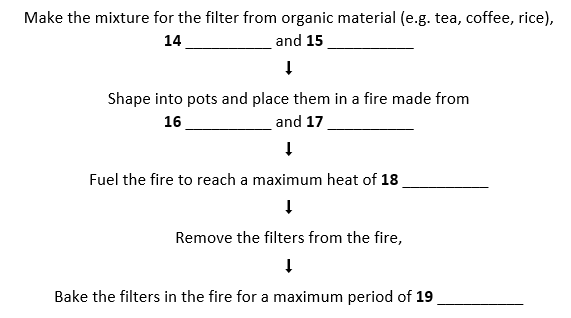
Complete the flow-chart below. Choose NO MORE THAN TWO WORDS AND/OR A NUMBER from the passage for each answer. Write your answers in boxes 14–19 on your answer sheet.
Step-by-step guide to making Flynn’s water filters
Diagram
14. Make the mixture for the filter from organic material (e.g. tea, coffee, rice),
15. and
16. Shape into pots and place them in a fire made from
17. and
18. Fuel the fire to reach a maximum heat of
19. Bake the filters in the fire for a maximum period of
Questions 20–23
Do the following statements agree with the information given in Reading Passage 2? In boxes 20–23 on your answer sheet, write: TRUE if the statement agrees with the information FALSE if the statement contradicts the information NOT GIVEN if there is no information on this
20. The clay in the Manatuto project was initially unsuitable for the project’s purpose.
21. Coffee grounds produce filters that are twice as efficient as those using other organic materials.
22. It takes half an hour for a cow-manure fire to reach 950 degrees.
23. E-coli is the most difficult bacterium to remove from water by filtration.
Questions 24–26
Choose the correct letter, A, B, C or D. Write the correct letter in boxes 24–26 on your answer sheet.
24. The Manatuto project aimed to set up a
25. To be effective, the Flynn filters must
26. Flynn does not intend to patent his filter because he

READING PASSAGE 3

You should spend about 20 minutes on Questions 27–40, which are based on Reading Passage 3.

Putting the brakes on climate change

Are hydrogen cars the answer?

A It is tempting to think that the conservation of coral reefs and rainforests is a separate issue from traffic and air pollution. But it is not. Scientists are now confident that rapid changes in the Earth’s climate are already disrupting and altering many wildlife habitats. Pollution from vehicles is a big part of the problem.

B The United Nation’s Climate Change Panel has estimated that the global average temperature rise expected by the year 2100 could be as much as 6°C, causing forest fires and dieback on land and coral bleaching in the ocean. Few species, if any, will be immune from the changes in temperature, rainfall and sea levels. The panel believes that if such catastrophic temperature rises are to be avoided, the quantity of greenhouse gases, especially carbon dioxide, being released into the atmosphere must be reduced. That will depend on slowing the rate of deforestation and, more crucially, finding alternatives to coal, oil and gas as our principal energy sources.

C Technologies do exist to reduce or eliminate carbon dioxide as a waste product of our energy consumption. Wind power and solar power are both spreading fast, but what are we doing about traffic? Electric cars are one possible option, but their range and the time it takes to charge their batteries pose serious limitations. However, the technology that shows the most potential to make cars climate-friendly is fuel-cell technology. This was actually invented in the late nineteenth century, but because the world’s motor industry put its effort into developing the combustion engine, it was never refined for mass production. One of the first prototype fuel-cell-powered vehicles has been built by the Ford Motor Company. It is like a conventional car, only with better acceleration and a smoother ride. Ford engineers expect to be able to produce a virtually silent vehicle in the future.

D So what’s the process involved — and is there a catch? Hydrogen goes into the fuel tank, producing electricity. The only emission from the exhaust pipe is water. The fuel-cell is, in some ways, similar to a battery, but unlike a battery it does not run down. As long as hydrogen and oxygen are supplied to the cell, it will keep on generating electricity. Some cells work off methane and a few use liquid fuels such as methanol, but fuel-cells using hydrogen probably have the most potential. Furthermore, they need not be limited to transport. Fuel-cells can be made in a huge range of size, small enough for portable computers or large enough for power stations. They have no moving parts and therefore need no oil. They just need a supply of hydrogen. The big question, then, is where to get it from.

E One source of hydrogen is water. But to exploit the abundant resource, electricity is needed, and if the electricity is produced by a coal-fired power station or other fossil fuel, then the overall carbon reduction benefit of the fuel-cell disappears. Renewable sources, such as wind and solar power, do not produce enough energy for it to be economically viable to use them in the ‘manufacture’ of hydrogen as a transport fuel. Another source of hydrogen is, however, available and could provide a supply pending the development of more efficient and cheaper renewable energy technologies. By splitting natural gas (methane) into its constituent parts, hydrogen and carbon dioxide are produced. One way round the problem of what to do with the carbon dioxide could be to store it back below ground – so called geological sequestration. Oil companies, such as Norway’s Statoil, are experimenting with storing carbon dioxide below ground in oil and gas wells.

F With freak weather conditions, arguably caused by global warming, frequently in the headlines, the urgent need to get fuel-cell vehicles will be available in most showrooms. Even now, fuel-cell buses are operating in the US, while in Germany a courier company is planning to take delivery of fuel-cell-powered vans in the near future. The fact that centrally-run fleets of buses and vans are the first fuel-cell vehicles identifies another challenge — fuel distribution. The refuelling facilities necessary to top up hydrogen-powered vehicles are available only in a very few places at present. Public transport and delivery firms are logical places to start, since their vehicles are operated from central depots.

G Fuel-cell technology is being developed right across the automotive industry. This technology could have a major impact in slowing down climate change, but further investment is needed if the industry — and the world’s wildlife — is to have a long-term future.

Questions 27–32
Reading Passage 3 has seven paragraphs, A–G. Choose the correct heading for paragraphs A–F from the list of headings below. Write the correct number, i–ix, in boxes 27–32 on your answer sheet.
List of Headings
i. Action already taken by the United Nations
ii. Marketing the hydrogen car
iii. Making the new technology available worldwide
iv. Some negative predictions from one group of experts
v. How the new vehicle technology works
vi. The history of fuel-cell technology
vii. A holistic view of climate change
viii. Locating the essential ingredient
ix. Sustaining car manufacture
27. Paragraph A
28. Paragraph B
29. Paragraph C
30. Paragraph D
31. Paragraph E
32. Paragraph F
Questions 33–36
Complete the sentences below. Choose NO MORE THAN TWO WORDS from the passage for each answer. Write your answers in boxes 33–36 on your answer sheet.
33. In the late nineteenth century, the car industry invested in the development of the , rather than fuel-cell technology.
34. Ford engineers predict that they will eventually design an almost car.
35. While a fuel-cell lasts longer, some aspects of it are comparable to a .
36. Fuel-cells can come in many sizes and can be used in power stations and in as well as in vehicles.
Questions 37–40
Do the following statements agree with the information given in Reading Passage 3? In boxes 37–40 on your answer sheet, write: TRUE if the statement agrees with the information FALSE if the statement contradicts the information NOT GIVEN if there is no information on this
37. Using electricity produced by burning fossil fuels to access sources of hydrogen may increase the positive effect of the fuel-cell.
38. The oil company Statoil in Norway owns gas wells in other parts of the world.
39. Public transport is leading the way in the application of fuel-cell technology.
40. More funding is necessary to ensure the success of the fuel-cell vehicle industry.
Reading – Real Tests Vol 3 – Test 3 – IELTS 7+ Cấp Tốc & Giao tiếp