Nhấn Enter để lưu • Esc để huỷ
Candidate: IELTS TEST TAKER
Kích Cỡ Chữ

Becoming an Expert

Exercise 1 - Definition Matching
Nối các từ vựng bên phải với định nghĩa tiếng Anh tương ứng (A, B, C...) ở cột bên trái.
A. Statistical charts used to assess risk and predict life expectancy, especially in insurance.
B. A person who is new to a field or activity and lacks experience.
C. Abstract rules or concepts that govern complex thinking and advanced problem-solving.
D. A structured learning system in which learners gain skills through hands-on practice under guidance.
E. A situation or statement that appears contradictory or illogical but may reveal a deeper truth.
F. Researchers who study mental processes such as thinking, learning, memory, and perception.
G. A skilled worker who has completed basic training but has not yet reached expert level.
H. Practical strategies or mental shortcuts used to make decisions or solve problems efficiently.
I. A strong sense of dedication or obligation to a task, goal, or responsibility.
J. A level of skill or knowledge gained through experience and extensive practice.
1. Expertise (n) – chuyên môn
2. Commitment (n) – sự cam kết, tận tụy
3. Novice (n) – người mới bắt đầu
4. Journeyman (n) – thợ lành nghề
5. Apprenticeship model (n phr) – mô hình học việc
6. Cognitive scientists (n phr) – các nhà khoa học nhận thức
7. Higher-order principles (n phr) – các nguyên tắc bậc cao
8. Heuristics (n) – phương pháp giải quyết vấn đề bằng suy nghiệm
9. Paradox (n) – nghịch lý
10. Actuarial tables (n phr) – bảng thống kê bảo hiểm/tuổi thọ
Exercise 2 - Sentence Completion
Quan sát danh sách từ vựng bên trái và gõ từ thích hợp vào chỗ trống trong từng câu bên phải.
Vocabulary List:
manifestations (n) – sự biểu hiện
coupled with (v phr) – đi đôi với
innate (adj) – bẩm sinh
perceptual (adj) – thuộc về tri giác
concurrently (adv) – đồng thời
consensus (n) – sự đồng thuận
superficial (adj) – hời hợt, nông cạn
forecasting (v/n) – dự báo
restrictive (adj) – hạn chế, gò bó
utility (n) – tính hữu dụng, tiện ích
1. The new policy was criticised for being too , as it limited teachers’ freedom in the classroom.
2. Weather has become more accurate thanks to satellite data and computer modelling.
3. Most experts reached a that urgent action was needed to reduce carbon emissions.
4. Some researchers believe that language learning depends partly on abilities present from birth.
5. The disease has several physical , including fever, tiredness, and skin irritation.
6. The device’s main lies in its ability to store large amounts of data in a small space.
7. His explanation was rather and failed to examine the deeper causes of the problem.
8. The experiment tested how people make judgements about colour, depth, and movement.
9. Rising temperatures, lower rainfall, have made farming more difficult in the region.
10. The two research teams worked on similar projects without knowing about each other’s findings.
Exercise 3 - Paraphrasing
Chọn câu diễn đạt tương đương (Paraphrase A, B, C...) ở cột bên phải tương ứng với từng câu gốc bên trái.
1. Expertise requires long-term commitment, creativity, and repeated exposure to many cases within a narrow field
2. Novices depend on mentors and rules to understand basic principles and examples
3. With practice, journeymen begin to recognise repeated patterns across different cases
4. Experts create new knowledge by testing predictions based on past experience
5. The apprenticeship model is still widely used in modern professional and academic training
6. Experts perceive meaningful patterns that novices cannot easily recognise
7. Experts solve problems differently by analysing them deeply before acting
8. Although experts excel in many areas, they are often poor at predicting future events
A. Experienced individuals often examine a problem carefully first, instead of rushing to find an immediate solution
B. Becoming highly skilled requires many years of focused effort and exposure to a large number of similar situations
C. People at an early stage of learning rely on teachers to explain rules and guide them through examples
D. Advanced learners begin to notice repeating patterns and connections between different situations
E. Many modern fields still train professionals through a system where learners gradually become independent experts
F. Experts are able to see important relationships in information that beginners usually miss
G. True expertise begins when individuals make predictions and test them rather than simply copying past examples
H. Research shows that experts are not always better than simple statistical methods at forecasting the future

Revolutions in Mapping

Exercise 1 - Definition Matching
Nối các từ vựng bên phải với định nghĩa tiếng Anh tương ứng (A, B, C...) ở cột bên trái.
A. Imaginary lines running from the North Pole to the South Pole, used to measure positions east or west on the Earth
B. The scientific study of religious beliefs, doctrines, and the nature of divinity
C. A mathematical method used to calculate how shapes, distances, or areas are altered when represented on maps
D. A system that uses sound waves to detect or locate objects underwater
E. Parallel lines on maps that indicate elevation or height above sea level
F. The total distance around a circular shape
G. A branch of science concerned with the creation, design, and interpretation of maps
H. Horizontal lines used to measure how far north or south a place is from the Equator
I. Regions of the Earth that share the same standard time
J. Vertical lines used to measure how far east or west a location is from the Prime Meridian
1. Cartography (n) – bản đồ học
2. Contours (n) – đường đồng mức
3. Sonar (n) – hệ thống định vị bằng sóng âm dưới nước
4. Circumference (n) – chu vi
5. Latitude (n) – vĩ độ
6. Longitude (n) – kinh độ
7. Meridians (n) – kinh tuyến
8. Time zones (n phr) – các múi giờ
9. Theology (n) – thần học
10. Distortion formula (n phr) – công thức tính độ biến dạng
Exercise 2 - Sentence Completion
Quan sát danh sách từ vựng bên trái và gõ từ thích hợp vào chỗ trống trong từng câu bên phải.
Vocabulary List:
utility (n) – tính hữu dụng, tiện ích
consensus (n) – sự đồng thuận
coupled with (v phr) – đi đôi với
superficial (adj) – hời hợt, nông cạn
restrictive (adj) – hạn chế, gò bó
forecasting (v/n) – dự báo
manifestations (n) – sự biểu hiện
perceptual (adj) – thuộc về tri giác
concurrently (adv) – đồng thời
innate (adj) – bẩm sinh
1. Researchers reached a broad that early childhood experiences can influence later development.
2. Her natural ability to recognise musical patterns appears to be largely rather than learned.
3. The device was praised for its practical rather than its appearance.
4. The company expanded into several international markets , rather than entering them one at a time.
5. Severe stress can produce physical such as headaches, tiredness, and sleep problems.
6. The economic recovery, increased consumer confidence, led to higher levels of investment.
7. Accurate weather is essential for farmers who need to plan planting and harvesting.
8. The study examined how processes affect the way people interpret colour and movement.
9. Critics argued that the report provided only a analysis of the problem and ignored its deeper causes.
10. The old regulations were considered too because they prevented researchers from testing new approaches.
Exercise 3 - Paraphrasing
Chọn câu diễn đạt tương đương (Paraphrase A, B, C...) ở cột bên phải tương ứng với từng câu gốc bên trái.
1. Modern mapmaking has expanded beyond human vision through the use of advanced technologies such as radar and satellites
2. The Library of Congress preserves both historic maps and modern digital mapping resources
3. Early scientific cartography began with accurately measuring the Earth’s size
4. Grid systems of latitude and longitude laid the foundation for modern mapping and time zones
5. The printing press and sea exploration transformed mapmaking from religious illustration to scientific knowledge
6. Map projections solve navigation problems but create distortions of land size and shape
7. Scientific land mapping advanced greatly through systematic surveys of an entire country
8. Despite technological progress, the core purpose of maps has remained unchanged
A. Although mapping tools have become more advanced, maps still aim to show where places are in relation to each other
B. New tools such as radar, sonar, and satellites allow mapmakers to record places that cannot be seen directly
C. National libraries store valuable historical maps while also supporting modern computer-based mapping
D. Early scholars made a major breakthrough by calculating the Earth’s circumference with impressive accuracy
E. Using lines of latitude and longitude helped organize maps and later influenced how time zones were created
F. The spread of printed maps and long-distance travel shifted mapmaking toward exploration and scientific understanding
G. Some map designs help sailors navigate easily but make certain regions appear much larger than they really are
H. Careful surveying methods made it possible to produce the first complete and accurate map of a whole nation

Sir Francis Ronalds and Telegraph

Exercise 1 - Definition Matching
Nối các từ vựng bên phải với định nghĩa tiếng Anh tương ứng (A, B, C...) ở cột bên trái.
A. A complete path through which an electric current flows
B. A system of long-distance communication using electrical signals transmitted over wires
C. Predictions or statements about events believed to happen in the future
D. Mechanical or energy force that enables a machine or system to operate
E. A visual signalling system that uses flags, arms, or lights to convey information
F. The government department responsible for naval affairs and maritime defence
G. Small lightweight spheres used in experiments to demonstrate electrical attraction and repulsion
H. A form of electricity caused by an imbalance of electric charges on a material’s surface
I. Technical skill in precise drawing, especially for engineering or architectural purposes
J. Subjects or fields of study that are closely related in theme or content
1. Telegraph (n) – máy điện báo
2. Draughtsmanship (n) – kỹ năng vẽ kỹ thuật
3. Motive power (n phr) – động lực, nguồn phát động
4. Statical electricity (n phr) – tĩnh điện
5. Circuit (n) – mạch điện
6. Pith balls (n phr) – quả cầu bấc (trong thí nghiệm điện)
7. Semaphore (n) – cờ hiệu quang báo
8. Admiralty (n) – Bộ Hải quân Anh
9. Kindred subjects (n phr) – các chủ đề liên quan
10. Prophecies (n) – lời tiên tri/dự đoán
Exercise 2 - Sentence Completion
Quan sát danh sách từ vựng bên trái và gõ từ thích hợp vào chỗ trống trong từng câu bên phải.
Vocabulary List:
patented (v/adj) – được cấp bằng sáng chế
unnecessary (adj) – không cần thiết
priority (n) – sự ưu tiên
synchronized (adj/v) – đồng bộ hóa
acquaintance (n) – người quen / sự quen biết
enthusiastically (adv) – một cách nhiệt tình
enclosed (v/adj) – được bao quanh
ingenious (adj) – khéo léo, tài tình
transmitted (v) – truyền đi
fruition (n) – sự thành hiện thực
1. The message was across the network within seconds.
2. Safety remains the top for the project team.
3. The courtyard is completely by tall stone walls.
4. What began as an idea finally came to after years of work.
5. She spoke about volunteering for the event.
6. An old introduced him to the opportunity.
7. The design is remarkably , solving multiple problems at once.
8. Their movements were carefully to the music.
9. Paying for extra features proved for most users.
10. The company revealed a newly device last week.
Exercise 3 - Paraphrasing
Chọn câu diễn đạt tương đương (Paraphrase A, B, C...) ở cột bên phải tương ứng với từng câu gốc bên trái.
1. Francis Ronalds showed early talent in science and mechanics and developed a strong interest in electricity
2. Ronalds built and tested one of the earliest electric telegraph systems using long wires and rotating dials
3. His telegraph system worked but was slow and depended on precise synchronization
4. Ronalds believed his invention could greatly improve long-distance communication across Britain
5. The British Admiralty rejected Ronalds’ telegraph, believing existing systems were sufficient
6. Although Ronalds did not patent his invention, later inventors benefited from his work
7. Ronalds later contributed significantly to meteorology through automatic data recording
8. Ronalds received official recognition for his early work only late in his life
A. His communication system functioned successfully, but messages were transmitted slowly and required careful timing
B. He showed an early curiosity for experiments and later focused much of his work on electrical science
C. Government authorities dismissed his invention because they felt there was no need for new communication methods
D. He imagined a future where electrical communication could connect distant cities quickly and efficiently
E. Other scientists later developed public telegraph systems based partly on his earlier experiments
F. He designed an early electric telegraph using long stretches of wire and rotating letter displays
G. In later years, he helped develop systems that automatically recorded weather information
H. Public and official praise for his contributions came many years after his original discoveries

READING PASSAGE 1

You should spend about 20 minutes on Questions 1–13, which are based on Reading Passage 1.

Becoming an Expert

Expertise is commitment coupled with creativity. Specifically, it is the commitment of time, energy, and resource to a relatively narrow field of study and the creative energy necessary to generate new knowledge in that field. It takes a considerable amount of time and regular exposure to a large number of cases to become an expert.

An individual enters a field of study as a novice. The novice needs to learn the guiding principles and rules of a given task in order to perform that task. Concurrently, the novice needs to be exposed to specific cases, or instances, that test the boundaries of such principles. Generally, a novice will find a mentor to guide her through the process of acquiring new knowledge. A fairly simple example would be someone learning to play chess. The novice chess player seeks a mentor to teach her the object of the game, the number of spaces, the names of the pieces, the function of each piece, how each piece is moved, and the necessary conditions for winning or losing the game.

In time, and with much practice, the novice begins to recognize patterns of behavior within cases and, thus, becomes a journeyman. With more practice and exposure to increasingly complex cases, the journeyman finds patterns not only within cases but also between cases. More importantly, the journeyman learns that these patterns often repeat themselves over time. The journeyman still maintains regular contact with a mentor to solve specific problems and learn more complex strategies. Returning to the example of the chess player, the individual begins to learn patterns of opening moves, offensive and defensive game-playing strategies, and patterns of victory and defeat.

When a journeyman starts to make and test hypotheses about future behavior based on past experiences, she begins the next transition. Once she creatively generates knowledge, rather than simply matching superficial patterns, she becomes an expert. At this point, she is confident in her knowledge and no longer needs a mentor as a guide — she becomes responsible for her own knowledge. In the chess example, once a journeyman begins competing against experts, makes predictions based on patterns, and tests those predictions against actual behavior, she is generating new knowledge and a deeper understanding of the game. She is creating her own cases rather than relying on the cases of others.

The chess example is a rather short description of an apprenticeship model. Apprenticeship may seem like a restrictive 18th-century mode of education, but it is still a standard method of training for many complex tasks. Academic doctoral programs are based on an apprenticeship model, as are fields like law, music, engineering, and medicine. Graduate students enter fields of study, find mentors, and begin the long process of becoming independent experts and generating new knowledge in their respective domains.

Psychologists and cognitive scientists agree that the time it takes to become an expert depends on the complexity of the task and the number of cases, or patterns, to which an individual is exposed. The more complex the task, the longer it takes to build expertise, or, more accurately, the longer it takes to experience and store a large number of cases or patterns.

An expert perceives meaningful patterns in her domain better than non-experts. Where a novice perceives random or disconnected data points, an expert connects regular patterns within and between cases. This ability to identify patterns is not an innate perceptual skill; rather, it reflects the organization of knowledge after exposure to and experience with thousands of cases. Experts have a deeper understanding of their domains than novices do, and utilize higher-order principles to solve problems. A novice, for example, might group objects together by color or size, whereas an expert would group the same objects according to their function or utility. Experts comprehend the meaning of data and weigh variables with different criteria within their domains better than novices.

Experts recognize variables that have the largest influence on a particular problem and focus their attention on those variables. Experts have better domain-specific short-term and long-term memory than novices do. Moreover, experts perform tasks in their domains faster than novices and commit fewer errors while problem solving. Interestingly, experts go about solving problems differently than novices. Experts spend more time thinking about a problem to fully understand it at the beginning of a task than novices, who immediately seek to find a solution. Experts use their knowledge of previous cases as context for increasing mental models to solve given problems.

Experts are more aware of instances where they have committed errors or failed to understand a problem. Experts check their solutions more often than novices and recognize when they are missing information necessary for solving a problem. Experts are aware of the limits of their domain knowledge and apply their domain heuristics to solve problems that fall outside their experience base. This is known as the paradox of expertise.

The strengths of expertise can also be weaknesses. Although one would expect experts to be good forecasters, they are not particularly good at making predictions about the future. Since the 1930s, researchers have been testing the ability of experts to make forecasts. The performance of experts has been tested against actuarial tables to determine if they are better at making predictions than simple statistical models. Seventy years later, with more than two hundred experiments in different domains, it is clear that the answer is no.

Theories and research differ when they try to explain why experts are less accurate forecasters than statistical models. Some have argued that experts, like all humans, are inconsistent when using mental models to make predictions. Others point to human biases to explain unreliable expert predictions. Despite decades of research, the literature shows little consensus regarding the causes or manifestations of human bias.
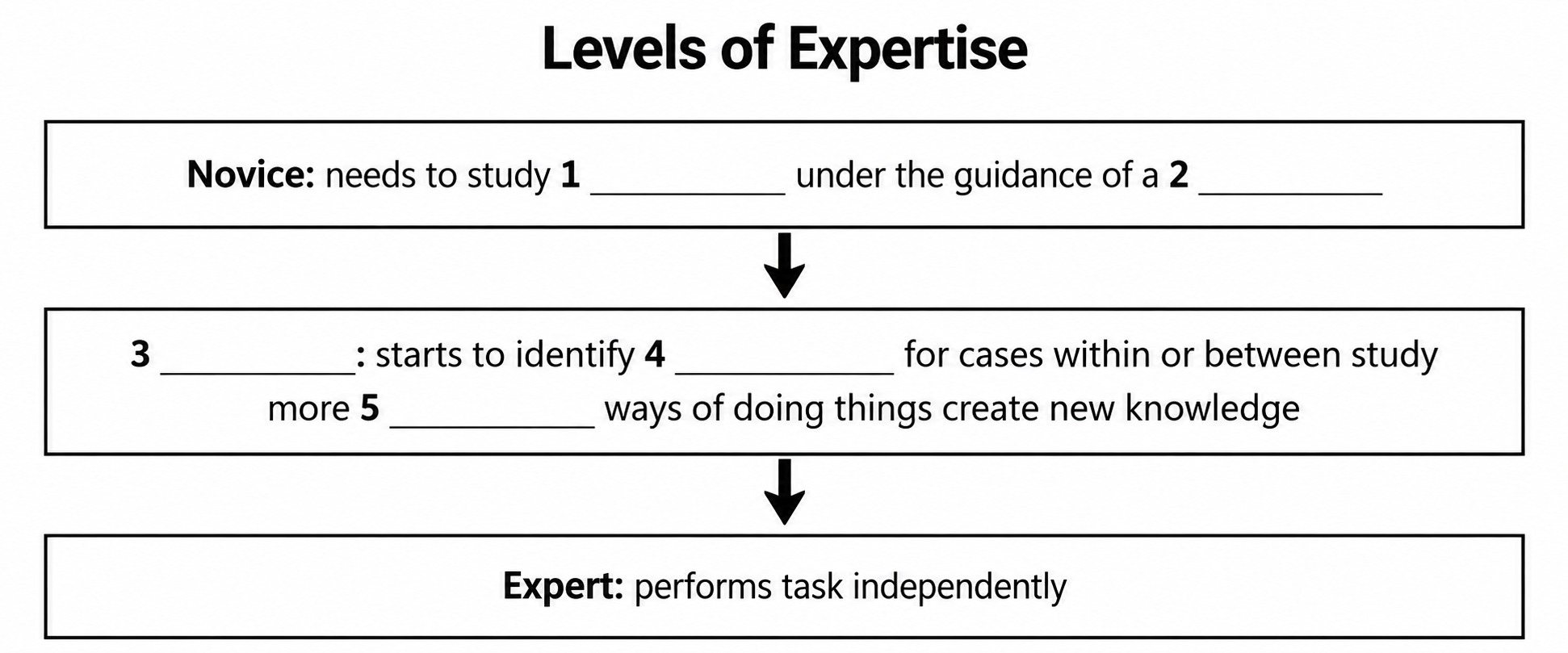
Questions 1-5
Complete the flow-chart below. Choose NO MORE THAN THREE WORDS from the passage for each answer.
Levels of Expertise
Diagram
1.
2.
3.
4.
5.
Questions 6-10
Do the following statements agree with the claims of the writer in Reading Passage 1? In boxes 6–10 on your answer sheet, write: TRUE if the statement agrees with the claims of the writer FALSE if the statement contradicts the claims of the writer NOT GIVEN if it is impossible to say what the writer thinks about this
6. Novices and experts use the same system of knowledge to comprehend and classify objects.
7. The focus of novices’ training is necessarily on long-term memory.
8. When working out the problems, novices want to solve them straight away.
9. When handling problems, experts are always more efficient than novices in their fields.
10. Experts tend to review more than novices on cases when flaws or limit on understanding took place.
Questions 11-13
Complete the following summary of the paragraphs of Reading Passage 1. Using NO MORE THAN TWO WORDS from the Reading Passage for each answer.
Why Expert Predictions Are Inaccurate

While experts outperform novices and machines in pattern recognition and problem solving, expert predictions of future behavior or events are seldom as accurate as simple actuarial tables. Why? Some have tried to explain that experts differ when using cognitive 11 to forecast. Researchers believe it is due to 12. However, attempting endeavour of finding answers did not yet produce 13.

READING PASSAGE 2

You should spend about 20 minutes on Questions 14–26, which are based on Reading Passage 2.

Revolutions in Mapping

Today, the mapmaker’s vision is no longer confined to what the human eye can see. The perspective of mapmaking has shifted from the crow’s nest of the sailing vessel, mountain top or airplane to ‘new orbital heights’. Radar, which bounces microwave radio signals off a given surface to create images of its contours and textures, can penetrate jungle foliage and has produced the first maps of the mountains of the planet Venus. And a combination of sonar and radar produces charts of the seafloor, putting much of Earth on the map for the first time. ‘Suddenly it’s a whole different world for us,’ says Joel Morrison, chief of geography at the U.S. Bureau of the Census. ‘Our future as mapmakers — even ten years from now — is uncertain.’

The world’s largest collection of maps resides in the basement of the Library of Congress in Washington, D.C. The collection, consisting of up to 4.6 million map sheets and 63,000 atlases, includes magnificent bound collections of elaborate maps — the pride of the golden age of Dutch cartography. In the reading rooms scholars, wearing thin cotton gloves to protect the fragile sheets, examine ancient maps with magnifying glasses. Across the room opposite sit at their computer screens, studying the latest maps, with their prodigious memories, computers are able to store data about people, places and environments — the stuff of maps — and almost instantly information is displayed on the screen in the desired geographic context, and at the click of a button, a print-out of the map appears.

Measuring the spherical Earth ranks as the first major milestone in scientific cartography. This was first achieved by the Greek astronomer Eratosthenes, a scholar at the famous Alexandrian Library in Egypt in the third century BC. He calculated the Earth’s circumference as 25,200 miles, which was remarkably accurate. The longitudinal circumference is known to be 24,860 miles.

Building on the ideas of his predecessors, the astronomer and geographer Ptolemy, working in the second century AD, spelled out a system for organizing maps according to grids of latitude and longitude. Today, parallels of latitude are often spaced at intervals of 10 to 20 degrees and meridians at 15 degrees, and this is the basis for the width of modern time zones. Another legacy of Ptolemy’s is his advice to cartographers to create maps to scale. Distance on today’s maps is expressed as a fraction or ratio of the real distance. But mapmakers in Ptolemy’s time lacked the geographic knowledge to live up to Ptolemy’s scientific principles. Even now, when surveyors achieve accuracies down to inches and satellites can plot potential missile targets within feet, maps are not true pictures of reality.

However, just as the compass improved navigation and created demand for useful charts, the invention of the printing press in the 15th century put maps in the hands of more people, and took their production away from monks, who had tended to illustrate theology rather than geography. Ocean-going ships launched an age of discovery, enlarging both what could and needed to be mapped, and awakened an intellectual spirit and desire for knowledge of the world.

Inspired by the rediscovered Ptolemy, whose writing had been preserved by Arabs after the sacking of the Alexandrian Library in AD 931, mapmakers in the 15th century gradually replaced theology with knowledge of faraway places, as reported by travelling merchants like Marco Polo.

Gerhardus Mercator, the foremost shipmaker of the 16th century, developed a technique for arranging meridians and parallels in such a way that navigators could draw straight lines between two points and steer a constant compass course between them. This distortion formula, introduced on his world map of 1569, created the ‘Greenland problem’. Even on standard maps to this day, Greenland looks as large as South America — one of many problems when one tries to portray a round world on a flat sheet of paper. But the Mercator projection was so practical that it is still popular with sailors.

Scientific mapping of the land came into its own with the achievements of the Cassini family — father, son, grandson and great-grandson. In the late 17th century, the Italian-born founder, Jean-Dominique, invented a complex method of determining longitude based on observations of Jupiter’s moons. Using this technique, surveyors were able to produce an accurate map of France. The family continued to map the French countryside and his great-grandson finally published the famous Cassini map in 1793 during the French Revolution. While it may have lacked the artistic appeal of earlier maps, it was the first model of a social and geographic map showing roads, rivers, canals, towns, abbeys, vineyards, lakes and even windmills. With this achievement, France became the first country to be completely mapped by scientific methods.

Mapmaking has come a long way since those days. Today’s surveyors rarely go into the field without being linked to navigation satellites. Their hand-held receivers are the most familiar of the new mapping technologies, and the satellite system, developed and still operated by the U.S. Defense Department, is increasingly used by surveyors. Even ordinary hikers, sailors and explorers can tap into it for data telling them where they are. Simplified civilian versions of the receivers are available for a few hundred dollars and they are also the heart of electronic map displays available in some cars. Cartography is pressing on to cosmic frontiers, but its objective is, and always has been, to communicate a sense of ‘here’ in relation to ‘there’, however far away ‘there’ may be.

Questions 14-18
Choose the correct letter, A, B, C or D.
14. According to the first paragraph, mapmakers in the 21st century
15. The Library of Congress is an opportunity to
16. Ptolemy alerted his contemporaries to the importance of
17. The invention of the printing press
18. The writer concludes by stating that
Questions 19-21
Look at the following list of achievements (Questions 19–21) and the list of mapmakers below. Match each achievement with the correct mapmaker, A, B, C or D.
List of Mapmakers
A. Mercator
B. Ptolemy
C. Cassini family
D. Eratosthenes
19. came very close to accurately measuring the distance round the Earth
20. produced maps showing man-made landmarks
21. laid the foundation for our modern time zones
Questions 22-26
Complete the summary below. Choose NO MORE THAN TWO WORDS from the passage for each answer.
The History of Mapmaking

Ancient maps allow us to see how we have come to make sense of the world. They also reflect the attitudes and knowledge of the day. The first great step in mapmaking took place in 22 in the 3rd century BC. Work continued in this tradition until the 2nd century AD but was then abandoned for over a thousand years, during which time maps were the responsibility of 23. Fortunately, however, the writings of 24 were revived by scholars in scientific mapmaking was revived as scholars sought to produce maps, inspired by the accounts of travellers. These days, 25 are vital to the creation of maps and radar has allowed cartographers to map areas around immediate world. In addition, this high-tech equipment is not only used to map faraway places, but cheaper versions have also been developed for use in 26.

READING PASSAGE 3

You should spend about 20 minutes on Questions 27–40, which are based on Reading Passage 3.

Sir Francis Ronalds and Telegraph

A Ronalds, Sir Francis (1788–1873), inventor of the electric telegraph and meteorologist, son of Francis Ronalds, a London merchant, and of his wife, Jane, daughter of William Field, was born in London on 21 Feb. 1788. Ronalds was educated at a private school at Cheshunt by the Rev. E. Cogan. At an early age he displayed a taste for experiment, and he acquired great skill later in practical mechanics and draughtsmanship. Under the influence of Jean André de Luc (1727–1817), whose acquaintance he made in 1814, he began to devote himself to practical electricity. In 1814 and 1815 he published several papers on electricity in Tilloch’s Philosophical Magazine, one of which records an ingenious use of De Luc’s electric column as a motive power for a clock.

B Ronalds’ name is chiefly remembered as the inventor of an electric telegraph. Since 1753, when the first proposal for an electric telegraph worked by statical electricity was made by a writer signing ‘C. M.’ (said to be Charles Morrison) in the Scots Magazine, successive advances had been made abroad by Volta, Le Sage, Lomond, Cavallo, Salva, and others; but much was needed to perfect the invention.

C In 1816 Francis Ronalds, then living at Upper Mall, Hammersmith, built in his back garden two frames accommodating eight miles of wire for his invention of an electrostatic telegraph. It used clockwork-driven rotating dials, engraved with letters of the alphabet and numbers, synchronized with each other, at both ends of the circuit. For the space of four years, encouraged by the octogenarian Swiss meteorologist Jean André de Luc, Ronalds had been enthusiastically experimenting with electrostatic clockwork devices. When someone desired to send a message he earthed the wire at his end at the moment when the dial indicated the desired letter. At the receiving end the pith balls would fall together when earthed and the recipient noted the letter showing on his dial at that moment. The system was slow and depended on the two dials staying in step, but Ronalds successfully transmitted and received letters over 150 metres of wire; later he succeeded in sending messages through eight miles of iron wire suspended above his garden in London.

D After sending messages along his wires on the frame, he developed another version in which the wires were enclosed in glass tubes buried in the ground. At each end of the line a clockwork mechanism synchronously revolving discs with letters on them. A frictional-electricity machine kept the wire continuously charged, while at each end two pith balls hung from fine wire on silk threads, and since they were similarly charged from the wire they stayed apart. When the wire was earthed at one end the balls fell together, indicating the letter on the disc then opposite. This was a very synchronously rotating disc, now employed in Hughes printing apparatus, was entirely his own. The only defect in his invention was the comparative slowness with which a succession of symbols could be transmitted.

E With communications between London and Portsmouth in mind, he believed his telegraph would work over distances of 800 km. In the same year, Ronalds wrote to offer his invention to the Admiralty. In fact, in 1806, Ralph Wedgwood submitted a telegraph based on frictional electricity to the Admiralty, but was told that the semaphore was sufficient for the country. In a pamphlet subsequently published, Ronalds suggested the establishment of a telegraph system with public offices in different centres. Francis Ronalds, in 1816, brought a similar telegraph of his invention to notice of the Admiralty, and was politely informed that ‘telegraphs of any kind are now wholly unnecessary’. John Barrow, Secretary to the Admiralty, replied that ‘telegraphs of any kind are now wholly unnecessary’, and on other than the one now in use will be adopted. The one in use was a semaphore system. Only a year after the end of the Napoleonic Wars, the Admiralty saw no need for improved communications, even though the semaphore was usable only in daylight and good weather.

F After this disappointment, Ronalds set off for the continent. He travelled throughout Europe and the Eastern Mediterranean, taking notes, sketching and collecting scientific books between 1816 and 1823. He had begun collecting his large library of works on electricity and kindred subjects. The last activity formed the beginnings of the Ronalds Library, left in trust to the IEE (now the IET) after his death. In a small pamphlet published in 1823, Ronalds described his invention and listed some of its possible uses, asking: ‘Why should not government govern at Portsmouth almost as promptly as in Downing Street? Why should our defaulters escape by default of our foggy climate? Let us have Electrical Conversation between communicating with each other all over the kingdom if we can.’

G However, Ronalds never patented his invention in electric telegraph. Ronalds seems to have made few or no practical contributions to science. In the meanwhile, one person did benefit from his work — Charles Wheatstone who saw the Ronalds telegraph at work. Later, the invention of an electric telegraph had been marvellously developed by Wheatstone, who had seen many of the Hammersmith experiments, in conjunction with Mr. William Fothergill Cooke, and these two men together devised and patented in 1837 the first electric telegraph used publicly and commercially in England. When, in 1855, controversy arose between Wheatstone and Cooke with regard to their respective shares in the invention, Wheatstone acknowledged his direct debt to Ronalds, and Cooke, though less fully, acknowledged the priority of Ronalds’ work. Until 1855 Ronalds’ share in the invention had been forgotten by the public.

H Early in 1843 Ronalds was made honorary director and superintendent of the Meteorological Observatory, which was then established at Kew by the British Association for the Advancement of Science. He began work on a system for registering meteorological data using photography and this was awarded a grant to continue his work. A similar system was developed independently by Charles Brooke, aided by Ronalds’ grant from the Royal Society, and independently about the same time. But the British Association confirmed Ronalds’ priority. This was the beginning of automatic, accurate recording of meteorological data and remained in use for some years after Ronalds’ death.

I Ronalds lived long enough to see his prophecies come to fruition and to receive belated official recognition: in 1870, three years before he died, he was knighted by Queen Elizabeth I, for his ‘early and remarkable labors in telegraphic investigations’.

Questions 27-31
Match each historical event with the correct year, A–G. Write the correct letter, A–G, in boxes 27–31 on your answer sheet.
Years
A. 1753
B. 1806
C. 1816
D. 1823
E. 1825
F. 1837
G. 1843
27. When did Francis Ronalds achieve a satisfactory result in the electricity experiment conducted first time?
28. When was the first proposal of an electric telegraph based on static electricity?
29. When did Ronalds get patent of his invention firstly?
30. Ronalds first made it known and revealed the applicable significance of his telegram to public.
31. The contribution being done by Ronalds’ invention in meteorological data.
Questions 32-35
Answer the questions below. Choose NO MORE THAN FOUR WORDS AND/OR A NUMBER from the passage for each answer.
Details of Ronalds' Telegraph System

32. What were carved in the experimental dials when doing Ronalds’ experiment in his garden?

33. What were enclosed with the buried telegram wires when Ronalds did the improved experiment?

34. What was the greatest distance Ronalds believed his telegram can send?

35. What kind of power supplied to keeping the wire charged continuously?

Questions 36-40
Reading Passage 3 has nine paragraphs, A–I. Which paragraph contains the following information? Write the correct letter, A–I, in boxes 36–40 on your answer sheet.
Paragraphs
A. Paragraph A
B. Paragraph B
C. Paragraph C
D. Paragraph D
E. Paragraph E
F. Paragraph F
G. Paragraph G
H. Paragraph H
I. Paragraph I
36. There is a commercial use of the telegram.
37. There is a contributory influence on Ronalds from a fellow he got to know.
38. Ronalds’ proposal was rejected as the preceding reference to another application.
39. There existed a drawback of Ronalds’ telegram.
40. Ronalds’ contribution in telegraphic investigations was recognized by authority.
Reading – Real Tests Vol 2 – Test 9 – IELTS 7+ Cấp Tốc & Giao tiếp

IELTS 7+ Cấp Tốc & Giao tiếp

Luyện IELTS band điểm cao từ 7.0


Reading – Real Tests Vol 2 – Test 9