Part 1 - Crime Report
Exercise 1 – Definition Matching
Match each word with its correct definition (A – J).
Match each word with its correct definition (A – J).
A. An official group responsible for maintaining law and order
B. A person who has been harmed or affected by a crime or incident
C. A personal identification document that allows someone to drive legally
D. A unique reference code given to a reported criminal case
E. A bag carried by hand, often used for personal items
F. The act of stealing someone else’s property
G. New or additional information provided after an earlier report
H. A fastening device used to open or close clothing or bags
I. A strap designed to carry a bag over the shoulder
J. A phone contact number used on a portable device
1. Constabulary [n] – lực lượng cảnh sát
2. Theft [n] – vụ trộm cắp
3. Handbag [n] – túi xách tay
4. Shoulder strap [np] – dây đeo vai
5. Zip fastener [np] – khóa kéo
6. Driving licence [np] – bằng lái xe
7. Crime number [np] – số hồ sơ tội phạm
8. Update [n] – sự cập nhật thông tin
9. Mobile number [np] – số điện thoại di động
10. Victim [n] – nạn nhân
Exercise 2 – Sentence Completion
Complete the sentences using the words from the box below.
Complete the sentences using the words from the box below.
Vocabulary List:
report [v] – báo cáo
proceed [v] – tiến hành
spell [v] – đánh vần
stolen [a] – bị lấy cắp
ordinary [a] – bình thường
plain [a] – trơn, đơn giản
valuables [n] – đồ có giá trị
forgetful [a] – hay quên
contact [v] – liên lạc
within the week [prep phrase] – trong vòng một tuần
1.
Guests are advised to keep their in the hotel safe at all times.
2.
If you have any questions, please the reception desk.
3.
The missing wallet was later confirmed as from the locker room.
4.
After the inspection is finished, we can with the next stage.
5.
He prefers a style with no unnecessary decoration.
6.
Could you your surname slowly for the record?
7.
She is quite , so reminders are sent by email.
8.
The apartment looks , but it is comfortable and clean.
9.
Please the accident to campus security immediately.
10.
The documents should arrive , according to the courier.
Exercise 3 – Paraphrasing
Match each original sentence (1 – 10) with its paraphrased equivalent (A – J).
Match each original sentence (1 – 10) with its paraphrased equivalent (A – J).
1. A woman contacts the police to report that her handbag has been stolen.
2. The officer records the victim’s personal details, including name and address.
3. There is some difficulty confirming spelling because of a poor phone connection.
4. The victim describes the handbag’s color, material, and handles.
5. The bag has minimal decoration and a zip closure.
6. Most valuable items were not inside the bag at the time of theft.
7. The stolen items include a purse containing money and a driving licence.
8. The officer requests a contact number to follow up on the case.
9. A crime reference number is issued to the victim.
10. The police promise to provide an update within a short period.
A. The woman is reassured that the police will give her further information in the coming days.
B. Because the phone line is unclear, the officer checks the spelling of key details.
C. The stolen handbag is described as plain, with light-colored leather and dark straps.
D. The victim phones the police to inform them about a stolen personal item.
E. Important electronics were not taken because they had been left at home.
F. A unique reference code is given so the incident can be tracked.
G. The officer asks for a phone number in case further contact is needed.
H. Only a small amount of cash and official identification were inside the bag.
I. The police collect identifying information before continuing with the report.
J. The bag includes a fastening mechanism at the top but no decorative features.
Part 2 - Hospitality Training Courses
Exercise 1 – Definition Matching
Match each word with its correct definition (A – J).
Match each word with its correct definition (A – J).
A. A person responsible for cleaning plates, utensils, and other kitchen items in a restaurant or hotel.
B. A document that summarizes a person's education, work experience, and skills, often used when applying for a job.
C. The practice of working in scheduled periods, often rotating between day and night.
D. The business sector that provides accommodation, food, and other services to customers, including hotels and restaurants.
E. A person who helps in the kitchen by preparing ingredients and assisting chefs.
F. Methods and practices that have been used for a long time, often passed down through generations.
G. The process of preparing for an event, presentation, or performance by practicing beforehand.
H. The ability to communicate effectively and present oneself well during a job application meeting.
I. A person responsible for carrying luggage and assisting guests in hotels, train stations, or airports.
J. To refresh or improve one's knowledge or ability in a particular skill.
1. Hospitality industry [np] – ngành dịch vụ khách sạn và nhà hàng
2. Kitchen assistant [np] – trợ lý bếp
3. Traditional techniques [np] – kỹ thuật truyền thống
4. Porter [n] – nhân viên khuân vác hành lý
5. Dishwasher [n] – nhân viên rửa bát
6. Shift work [np] – công việc theo ca
7. Interview skills [np] – kỹ năng phỏng vấn
8. Resume (CV) [np] – sơ yếu lý lịch
9. Rehearsal [n] – sự luyện tập, diễn tập
10. Brush up on [vp] – cải thiện, ôn lại kỹ năng
Exercise 2 – Sentence Completion
Complete the sentences using the words from the box below.
Complete the sentences using the words from the box below.
Vocabulary List:
Porter [n] – nhân viên khuân vác hành lý
Interview skills [np] – kỹ năng phỏng vấn
Dishwasher [n] – nhân viên rửa bát
Hospitality industry [np] – ngành dịch vụ khách sạn và nhà hàng
Rehearsal [n] – sự luyện tập, diễn tập
Traditional techniques [np] – kỹ thuật truyền thống
Kitchen assistant [np] – trợ lý bếp
Brush up on [vp] – cải thiện, ôn lại kỹ năng
Shift work [np] – công việc theo ca
Resume (CV) [np] – sơ yếu lý lịch
1.
The helped guests carry their luggage to their rooms at the hotel.
2.
Practicing can help you feel more confident and prepared for job interviews.
3.
After the busy dinner service, the stayed late to clean all the pots and pans.
4.
Working in the requires excellent customer service skills and a friendly attitude.
5.
Before the big presentation, the team had a to ensure everything went smoothly.
6.
Many chefs still use to create authentic dishes that have been passed down through generations.
7.
As a , you will help chefs prepare ingredients and keep the kitchen clean.
8.
I need to my language skills before applying for a job in an international hotel.
9.
In the , employees often work early mornings, late nights, or weekends.
10.
Make sure to update your with your latest work experience and qualifications.
Exercise 3 – Paraphrasing
Match each original sentence (1 – 10) with its paraphrased equivalent (A – J).
Match each original sentence (1 – 10) with its paraphrased equivalent (A – J).
1. The speaker introduces himself and his long experience in the hospitality industry.
2. The information day includes presentations in the morning and workshops in the afternoon.
3. Kitchen assistant roles offer valuable cooking experience but require long working hours.
4. Jobs such as porter, cleaner, and dishwasher are suitable for students with no experience.
5. Porters play a key role in shaping guests’ first impressions of a hotel.
6. Reception work is important for career development but involves high pressure.
7. Interview skills are essential for hospitality jobs and can be improved through practice.
8. Workshop locations are spread across different parts of the college campus.
9. Clear directions are given to help participants find each specific workshop.
10. The interview skills workshop is located separately from the others near the square.
A. Some entry-level hospitality positions are ideal for students because they do not require previous training.
B. One workshop focuses on preparing for job interviews and is held in a large classroom near the central square.
C. Participants are guided carefully so they can locate each workshop without difficulty.
D. Receptionists must handle many hotel responsibilities and manage stressful situations effectively.
E. The speaker begins by explaining his background and years of work in hospitality worldwide.
F. Those working in kitchens can gain strong practical skills but must be ready for demanding schedules.
G. Attendees will first listen to short talks before taking part in more detailed practical sessions later.
H. Porters influence how guests perceive a hotel because they are often the first staff members encountered.
I. Learning how to perform well in interviews is important and does not require extensive training to improve.
J. Each workshop takes place in a different building or classroom across the campus.
Part 3 - Battery-Powered Motorbikes
Exercise 1 – Definition Matching
Match each word with its correct definition (A – J).
Match each word with its correct definition (A – J).
A. The process of making modifications to improve or adjust something to suit new conditions.
B. A list of books, articles, and other sources used in research or writing.
C. A stage in product development where an early model is created for testing and refinement.
D. A vehicle that operates using gasoline as its primary fuel source.
E. A method of presenting information using images, diagrams, or other graphical elements.
F. The practice of reviewing and correcting written text for errors in grammar, spelling, and clarity.
G. An initial drawing that illustrates an idea or design before it is developed further.
H. Drawings that focus on the movement of air around an object to improve efficiency and reduce resistance.
I. People or organizations within a particular field who can provide professional support or opportunities.
J. Designed to minimize harm to nature by reducing waste, pollution, or energy consumption.
1. Environmentally friendly [a] – thân thiện với môi trường
2. Petrol-driven bikes [np] – xe máy chạy bằng xăng
3. Prototype stage [np] – giai đoạn nguyên mẫu
4. Visuals [n] – hình ảnh trực quan
5. Proofread [v] – đọc và sửa lỗi
6. Bibliography [n] – tài liệu tham khảo
7. Concept sketches [np] – bản phác thảo ý tưởng
8. Aerodynamic sketches [np] – bản phác thảo khí động học
9. Adaptations [n] – điều chỉnh, cải tiến
10. Industry contacts [np] – mối quan hệ trong ngành
Exercise 2 – Sentence Completion
Complete the sentences using the words from the box below.
Complete the sentences using the words from the box below.
Vocabulary List:
Aerodynamic sketches [np] – bản phác thảo khí động học
Proofread [v] – đọc và sửa lỗi
Environmentally friendly [a] – thân thiện với môi trường
Prototype stage [np] – giai đoạn nguyên mẫu
Visuals [n] – hình ảnh trực quan
Adaptations [n] – điều chỉnh, cải tiến
Petrol-driven bikes [np] – xe máy chạy bằng xăng
Bibliography [n] – tài liệu tham khảo
Concept sketches [np] – bản phác thảo ý tưởng
Industry contacts [np] – mối quan hệ trong ngành
1.
The design team created several to explore the shape and airflow of the new car model.
2.
Before submitting the report, make sure to it carefully to avoid any spelling or grammar mistakes.
3.
The company is committed to producing products that reduce waste and pollution.
4.
At the , the product is still being tested and refined before mass production.
5.
The presentation included impressive , such as charts, graphs, and photos, to help explain the data.
6.
The engineer made several to the original design to improve its performance.
7.
are becoming less popular as people switch to electric vehicles for a greener future.
8.
The research paper included a detailed listing all the sources used.
9.
The designer shared some to give the team a rough idea of the product’s appearance.
10.
Building strong is essential for finding new opportunities and collaborations in your field.
Exercise 3 – Paraphrasing
Match each original sentence (1 – 10) with its paraphrased equivalent (A – J).
Match each original sentence (1 – 10) with its paraphrased equivalent (A – J).
1. The students feel proud that their project was selected for the university Open Day.
2. The motorbike challenges the idea that environmentally friendly vehicles are slow.
3. The bike is highly efficient and mechanically simpler than petrol-powered models.
4. Preparing the presentation is difficult due to limited time and other commitments.
5. They plan to balance presenting information with allowing time for audience questions.
6. Showing a short race video is suggested as an engaging way to start the presentation.
7. They consider using visuals rather than text-heavy slides.
8. The students debate whether to consult lecturers or senior students for guidance.
9. Writing the project report was demanding, especially managing its length.
10. The tutor’s guidance and industry connections proved valuable during the project.
A. Creating the written report was challenging, particularly keeping it within the required word limit.
B. Advice from an experienced student and the tutor was seen as helpful before finalising the presentation.
C. They believe their project stood out enough to be chosen over others for public display.
D. A brief video of the motorbike in action could capture the audience’s interest immediately.
E. Their electric motorbike disproves the assumption that green vehicles lack speed.
F. Time pressure makes preparing the talk difficult because of other academic responsibilities.
G. The bike’s design is lighter and more efficient due to fewer mechanical components.
H. The tutor’s involvement became especially useful during the practical stages of the project.
I. They want to include both structured content and opportunities for the audience to ask questions.
J. Using photographs and visual material is preferred over slides filled with written text.
Part 4 - Trial Courtroom Procedures
Exercise 1 – Definition Matching
Match each word with its correct definition (A – J).
Match each word with its correct definition (A – J).
A. The person who brings a legal case against another party in court
B. The decision reached at the end of a trial
C. The area in a courtroom where jurors sit during proceedings
D. The principle of keeping information private and not disclosed
E. A raised place in court where a witness gives testimony
F. An official who keeps records and manages documents for the court
G. A formal request asking for leniency in sentencing
H. A trained officer who maintains order and security in the courtroom
I. The person accused of a crime in a legal case
J. A professional who creates a written transcript of everything said in court
1. Witness stand [np] – bục nhân chứng
2. Court reporter [np] – người ghi chép tại tòa
3. Bailiff [n] – nhân viên thực thi pháp luật tại tòa
4. Court clerk [np] – thư ký tòa án
5. Defendant [n] – bị cáo
6. Plaintiff [n] – nguyên đơn
7. Jury box [np] – khu vực dành cho bồi thẩm đoàn
8. Final verdict [np] – phán quyết cuối cùng
9. Confidentiality [n] – sự bảo mật
10. Recommendation of mercy [np] – kiến nghị khoan hồng
Exercise 2 – Sentence Completion
Complete the sentences using the words from the box below.
Complete the sentences using the words from the box below.
Vocabulary List:
unanimous [a] – nhất trí
adjacent [a] – liền kề
unauthorised [a] – không được phép
impartial [a] – công bằng, không thiên vị
disrespectful [a] – thiếu tôn trọng
proclaimed [v] – tuyên bố
mutual consent [np] – sự đồng thuận từ hai phía
invariably [adv] – luôn luôn
unbiased [a] – không thiên kiến
elevated [a] – được nâng cao
1.
The committee reached a decision after a long discussion.
2.
The two buildings are , sharing the same parking area.
3.
Any access to the site will result in a fine.
4.
The judge was expected to remain throughout the trial.
5.
He spoke in a tone that offended several colleagues.
6.
The mayor the new policy during a press conference.
7.
The agreement was signed only after was obtained.
8.
Prices have increased during the holiday season.
9.
The platform aims to provide reporting on current events.
10.
The gallery is located on an level above the main hall.
Exercise 3 – Paraphrasing
Match each original sentence (1 – 10) with its paraphrased equivalent (A – J).
Match each original sentence (1 – 10) with its paraphrased equivalent (A – J).
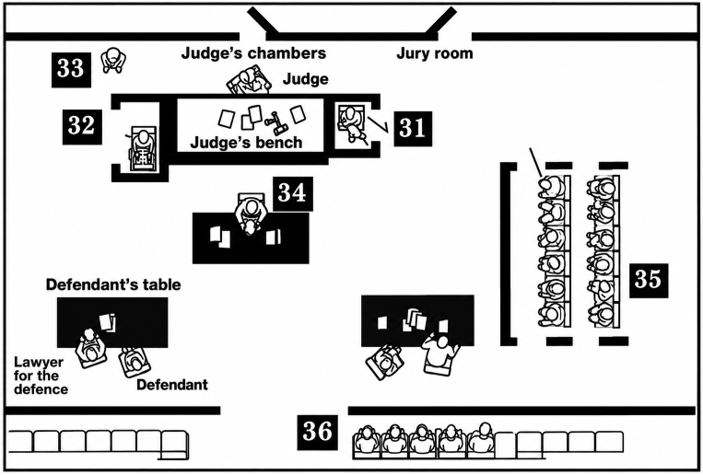
1. The judge sits in an elevated position overseeing the courtroom.
2. Key court officials are positioned close to the judge’s bench.
3. The bailiff is responsible for maintaining order and enforcing procedure.
4. The central courtroom area has strict rules about movement.
5. The defendant and prosecution occupy opposite sides of the courtroom.
6. The jury plays a crucial role in deciding the case outcome.
7. Public observers are separated from legal participants.
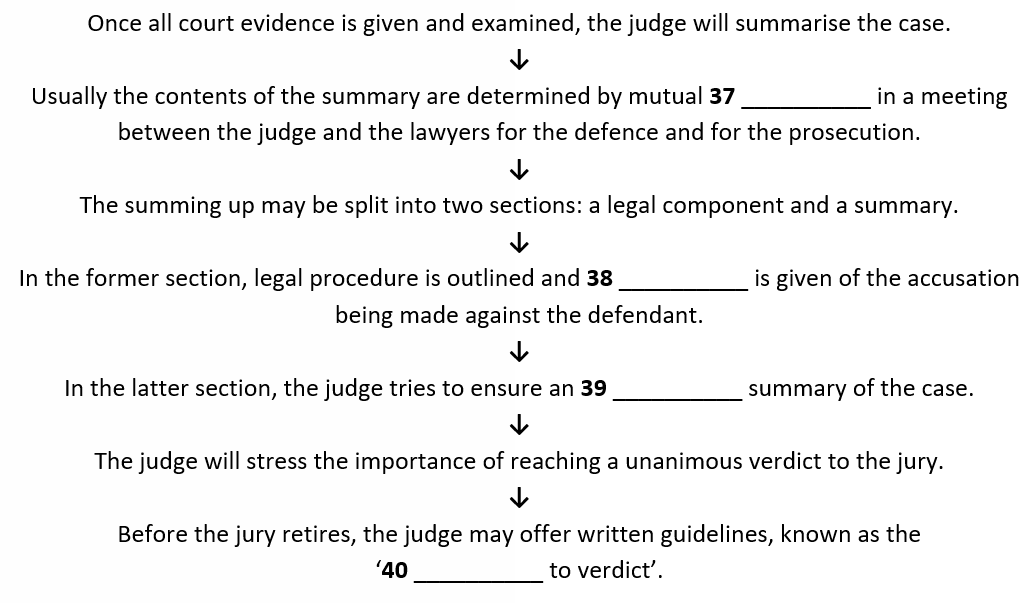
8. The judge consults lawyers before summarizing the case.
9. The jury is reminded of legal rules and factual evidence.
10. Written guidance may be provided to assist jury decision-making.
A. Members of the public are seated behind a designated boundary that separates them from the legal process.
B. Only authorized personnel are permitted to cross the courtroom’s central area during a trial.
C. A group of citizens listens to the case and is responsible for delivering a final decision.
D. Before addressing the jury, the judge discusses the content of the summary with both legal teams.
E. The courtroom authority figure is positioned higher than everyone else to preside over proceedings.
F. Court officials positioned near the judge support record-keeping and courtroom control.
G. The accused person sits alongside a defense lawyer, opposite the legal representative bringing the case.
H. The jury may receive a structured written guide to help them reach an agreement in complex cases.
I. An officer ensures that rules are followed and behavior remains appropriate throughout the trial.
J. The judge presents a balanced explanation of legal requirements and key facts before deliberation begins.