Part 1 - Sending a Package Overseas
Exercise 1: Definition Matching
Match each word or phrase with its correct definition (A – J).
Match each word or phrase with its correct definition (A – J).
A. The person who receives a letter, parcel or other item.
B. An official slip showing that money has been paid or an item has been accepted.
C. A service used to send something quickly from one country to another.
D. The items that are placed inside a parcel for delivery.
E. The government department that checks goods entering or leaving a country.
F. A day when businesses and offices are normally open.
G. A document used to record information about a parcel being sent.
H. The country where a parcel or shipment is being sent.
I. A number or combination of characters used to identify and track something.
J. The person who sends a letter, parcel or shipment.
1. Package delivery form [np] – phiếu gửi bưu kiện
2. International Express [np] – dịch vụ chuyển phát quốc tế nhanh
3. Working day [np] – ngày làm việc
4. Country of destination [np] – quốc gia nhận hàng
5. Sender [n] – người gửi
6. Recipient [n] – người nhận
7. Package contents [np] – đồ vật bên trong bưu kiện
8. Receipt [n] – biên lai
9. ID code [np] – mã nhận dạng
10. Customs [n] – hải quan
Exercise 2: Sentence Completion
Complete the sentences using the words from the box below.
Complete the sentences using the words from the box below.
Vocabulary List:
urgently [adv] – khẩn cấp
slightly more expensive [adj phrase] – đắt hơn một chút
as quickly as possible [adv phrase] – nhanh nhất có thể
in total [adv phrase] – tổng cộng
insure [v] – mua bảo hiểm cho
weigh [v] – cân
go missing [vp] – bị thất lạc
trace [v] – theo dõi, truy tìm
contact [v] – liên hệ
just in case [adv phrase] – phòng khi
1.
Keep a copy of the reference number you need to report a problem later.
2.
The company can use the tracking number to the parcel if it does not arrive.
3.
The package needs to arrive because the documents are required tomorrow.
4.
The express service is , but it reaches the destination much sooner.
5.
Customers should the post office immediately if their parcel has not arrived.
6.
The clerk placed the box on a machine to it before calculating the delivery fee.
7.
There are six books and several photographs in the parcel .
8.
Valuable items should be against loss or damage during delivery.
9.
The customer wanted the parcel delivered .
10.
Although parcels rarely , customers should keep their receipts.
Exercise 3 – Paraphrasing
Match each original sentence (1 – 10) with its paraphrased equivalent (A – J).
Match each original sentence (1 – 10) with its paraphrased equivalent (A – J).
1. The customer needs the package to reach the USA no later than Friday.
2. He chooses International Express because the regular postal service would take too long.
3. The sender lives at 14 Mountain Road in Lakeview.
4. The package is being sent to Anna Hillman in New York.
5. The parcel contains six books and some photographs.
6. The customer decides that insuring the package would be sensible.
7. The package weighs slightly more than four kilograms.
8. The total cost of sending it is $98.
9. If the parcel is lost, the customer should contact the postal service quickly.
10. The ID code printed on the receipt is sufficient to trace a missing package.
A. The tracking number on the proof of payment is all that is needed to locate the shipment.
B. The customer agrees that protecting the contents financially against loss is a good idea.
C. The chosen delivery service costs more but is fast enough to meet the deadline.
D. The shipment includes printed materials as well as personal pictures.
E. The parcel must arrive before the end of the working week.
F. The final charge for the international delivery comes to ninety-eight dollars.
G. The destination address belongs to a woman living in New York.
H. In the event of non-delivery, the sender should notify the postal company without delay.
I. The person sending the parcel gives a residential address in Lakeview.
J. When placed on the scales, the parcel is found to weigh a little over four kilos.
Part 2 - The Montana Resort Hotel
Exercise 1: Definition Matching
Match each word or phrase with its correct definition (A – J).
Match each word or phrase with its correct definition (A – J).
A. A large area of land specially designed for playing golf.
B. High-quality restaurant food served in a formal or elegant setting.
C. A hotel designed mainly for holidays and relaxation.
D. A door that directly joins two neighbouring rooms.
E. A room offering more space and facilities than a normal hotel room.
F. An experienced and highly skilled professional cook.
G. The route regularly followed by aircraft through the air.
H. Facilities provided outside a building for recreation or sport.
I. A marked area where the sport of tennis is played.
J. A normal hotel room offering the basic level of accommodation.
1. Resort hotel [np] – khách sạn nghỉ dưỡng
2. Flight path [np] – đường bay
3. Standard room [np] – phòng tiêu chuẩn
4. Deluxe suite [np] – phòng suite cao cấp
5. Connecting door [np] – cửa thông giữa hai phòng
6. Fine dining [np] – ẩm thực cao cấp
7. Master chef [np] – đầu bếp bậc thầy
8. Tennis court [np] – sân tennis
9. Golf course [np] – sân golf
10. Outdoor facilities [np] – tiện ích ngoài trời
Exercise 2: Sentence Completion
Complete the sentences using the words from the box below.
Complete the sentences using the words from the box below.
Vocabulary List:
exceptionally located [adj phrase] – có vị trí đặc biệt thuận lợi
recharge your batteries [vp] – nghỉ ngơi để lấy lại năng lượng
spacious [a] – rộng rãi
price-conscious [a] – quan tâm đến giá cả
adjoin [v] – nằm liền kề
substantial [a] – đầy đủ, đáng kể
sizzle [v] – xèo xèo khi nấu
bend around [vp] – uốn vòng quanh
spread off [vp] – trải rộng về phía
host [v] – tổ chức
1.
The hotel hopes to an international sporting event next year.
2.
The road begins beside the lake and then toward the entrance.
3.
The rooms are extremely , with enough space for large beds and furniture.
4.
Travellers on a limited budget tend to be more when choosing accommodation.
5.
Two family rooms each other and can be linked by an internal door.
6.
Guests come to this peaceful resort to relax and after a stressful week.
7.
The property is because it is near the city but away from airport noise.
8.
The smell of meat beginning to on the grill filled the restaurant.
9.
The golf course continues to toward the west for a considerable distance.
10.
Guests who want more than a snack can order a meal at the café.
Exercise 3 – Paraphrasing
Match each original sentence (1 – 10) with its paraphrased equivalent (A – J).
Match each original sentence (1 – 10) with its paraphrased equivalent (A – J).
1. The hotel is conveniently close to the city but far enough from the airport flight path to remain peaceful.
2. Standard rooms cost between $145 and $210.
3. Every deluxe suite has a balcony with views of either the mountains or the golf course.
4. Families can obtain extra beds for young children without paying an additional fee.
5. Some rooms have connecting doors so parents can easily check on their children.
6. Guests in the Grill Room can watch chefs cooking their food.
7. The hotel has a barn containing twelve trained horses.
8. The swimming pool has twelve lanes and a separate pool for small children.
9. The golf course has eighteen holes and may eventually host a professional tournament.
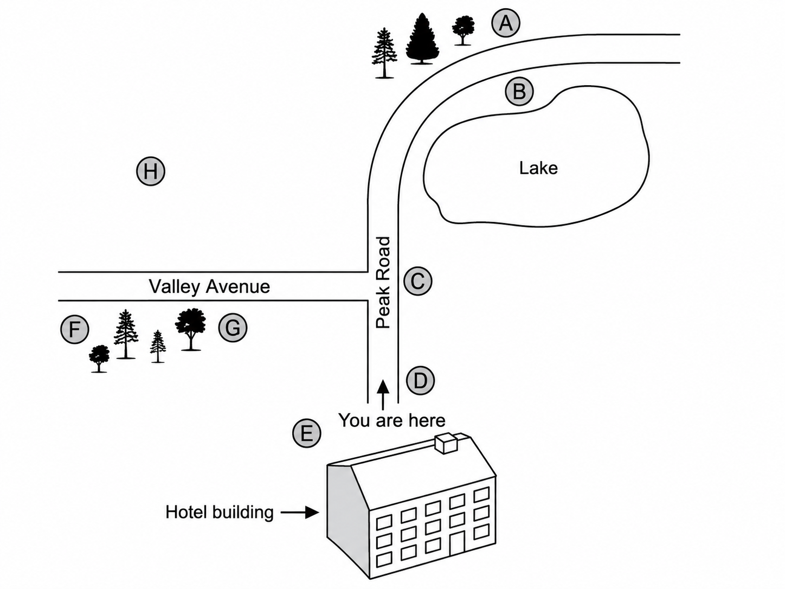
10. The outdoor facilities manager's office is opposite the turn into Valley Avenue.
A. Parents can stay close to their children by booking neighbouring rooms joined internally.
B. The main pool is designed for serious swimming, while younger children have their own smaller area.
C. The least expensive standard accommodation costs $145, while the highest price is $210.
D. The property combines easy access to the city with a location protected from aircraft noise.
E. Guests eating in one restaurant are able to observe their meals being prepared.
F. There is no extra charge for providing additional sleeping arrangements for young children.
G. A building close to the hotel houses a dozen horses familiar with the local landscape.
H. The office responsible for outdoor activities stands directly across from the junction with Valley Avenue.
I. The larger rooms include outdoor seating areas overlooking one of two different landscapes.
J. The hotel's major outdoor attraction is a full-size golf facility that the management hopes will be used for a major competition.
Part 3 - Oral History Project
Exercise 1: Definition Matching
Match each word or phrase with its correct definition (A – J).
Match each word or phrase with its correct definition (A – J).
A. A person who answers questions during a research interview.
B. A collection of old newspapers preserved for research.
C. The methods and procedures used to conduct academic research.
D. Information preserved so that future researchers can study past events.
E. Equipment used to capture and store spoken sound.
F. A printed sheet given to students during a class or lecture.
G. The process of analysing information and judging its meaning or importance.
H. A list containing people's names and telephone numbers.
I. The study of the past through recorded conversations with people who experienced events.
J. Technology used for recording, storing or reproducing sound.
1. Oral history [np] – lịch sử truyền miệng
2. Research methodology [np] – phương pháp nghiên cứu
3. Lecture handout [np] – tài liệu phát trong bài giảng
4. Audio technology [np] – công nghệ âm thanh
5. Historical record [np] – tư liệu lịch sử
6. Newspaper archive [np] – kho lưu trữ báo chí
7. Telephone directory [np] – danh bạ điện thoại
8. Recording equipment [np] – thiết bị ghi âm
9. Interviewee [n] – người được phỏng vấn
10. Data evaluation [np] – việc đánh giá dữ liệu
Exercise 2: Sentence Completion
Complete the sentences using the words from the box below.
Complete the sentences using the words from the box below.
Vocabulary List:
socially important [adj phrase] – quan trọng về mặt xã hội
preserved forever [vp] – được lưu giữ vĩnh viễn
track down [vp] – tìm ra
complex [a] – phức tạp
allot [v] – phân bổ
unreliable [a] – không đáng tin cậy
specific [a] – cụ thể
refine [v] – tinh chỉnh
factual [a] – thiên về sự kiện, dữ kiện
include your own evaluation [vp] – đưa đánh giá của bản thân vào
1.
The researcher's questions were too for participants to answer easily in conversation.
2.
A good academic report should do more than repeat information; it should .
3.
The student managed to several former players by using an old directory.
4.
The tutor advised him to make his topics more instead of asking very general questions.
5.
Digital files can potentially be if they are properly stored and backed up.
6.
The old recorder was considered because it sometimes stopped working unexpectedly.
7.
The researcher needs to enough time for each interview without making it unnecessarily long.
8.
The project examines memories that are historically or to the local community.
9.
The student agreed to his questions after receiving feedback from his tutor.
10.
A report that simply describes what happened may be too and lack analysis.
Exercise 3 – Paraphrasing
Match each original sentence (1 – 10) with its paraphrased equivalent (A – J).
Match each original sentence (1 – 10) with its paraphrased equivalent (A – J).
1. Oral history records interviews about past events that are historically or socially significant.
2. Unlike many textbooks, oral history can focus on ordinary people's everyday experiences.
3. The internet allows recorded interviews to be preserved permanently.
4. Mike chose a football-related topic partly because his father is a strong supporter of the team.
5. The local newspaper archives provided the most useful background information.
6. Mike located former players using a telephone directory.
7. The tutor thinks Mike's interview questions are too complicated.
8. The amount of time planned for each interview is longer than necessary.
9. Mike's recorder is unreliable and therefore requires backup equipment.
10. The final report should analyse the interview material rather than merely describe what people said.
A. The student's main research source was a collection of old reports published in the local press.
B. The proposed write-up needs interpretation of the evidence rather than just a chronological account.
C. A traditional phone listing helped the student find people who had played for the team.
D. Digital technology prevents recorded interviews from deteriorating in the way old tapes did.
E. The tutor recommends shortening the planned duration of each conversation.
F. The research method captures first-hand memories of events considered important to society or history.
G. Because the recording device cannot always be trusted, spare equipment should be available.
H. One reason for selecting the sports project is a close family member's enthusiasm for the club.
I. The interview questions need simplifying so that participants can respond to them more easily.
J. This research approach can document the lives of people who would rarely appear in conventional history books.
Part 4 - Plant Behaviour
Exercise 1: Definition Matching
Match each word or phrase with its correct definition (A – J).
Match each word or phrase with its correct definition (A – J).
A. A plant from which another organism obtains the resources it needs to survive.
B. A plant that produces food eaten by people or animals.
C. A scientific field concerned with how plants live, grow and respond to their environment.
D. A characteristic pattern that allows one kind of plant to be distinguished from another.
E. A recording technique that shows a slow process happening much faster.
F. The ways in which plants respond to things around them.
G. A group of plants sharing the same biological characteristics.
H. A parasitic plant that grows around other plants and obtains resources from them.
I. Substances in the ground that plants absorb in order to grow.
J. A wild coastal plant studied for its ability to recognise related plants.
1. Plant behaviour [np] – hành vi của thực vật
2. Plant species [np] – loài thực vật
3. Sea rocket [np] – cây sea rocket
4. Soil nutrients [np] – chất dinh dưỡng trong đất
5. Plant signature [np] – dấu hiệu đặc trưng của loài cây
6. Dodder plant [np] – cây tơ hồng
7. Food crop [np] – cây lương thực
8. Host plant [np] – cây chủ
9. Time-lapse video [np] – video tua nhanh thời gian
10. Plant science [np] – khoa học thực vật
Exercise 2: Sentence Completion
Complete the sentences using the words from the box below.
Complete the sentences using the words from the box below.
Vocabulary List:
passive [a] – thụ động
sophisticated [a] – tinh vi, phức tạp
soak up [vp] – hấp thụ
recognise [v] – nhận biết
reflect [v] – phản chiếu
convert [v] – chuyển đổi
infest [v] – xâm hại, phá hoại
devastating [a] – gây thiệt hại nghiêm trọng
release [v] – giải phóng, tiết ra
resemble [v] – trông giống
1.
Some parasitic plants can crops and cause serious losses for farmers.
2.
Researchers now believe plants are less than scientists once assumed.
3.
The young plant appeared to a worm as it moved towards its target.
4.
Leaves can sunlight, which allows other organisms to detect differences between species.
5.
Plants may large quantities of nutrients through their roots when competing with neighbours.
6.
Some plants appear able to whether nearby plants are related to them.
7.
Certain species can nutrients into substances needed for growth.
8.
The parasite detects chemicals that other plants into the surrounding air and soil.
9.
Modern experiments suggest plants respond to their surroundings in surprisingly ways.
10.
A serious infestation can have a effect on agricultural production.
Exercise 3 – Paraphrasing
Match each original sentence (1 – 10) with its paraphrased equivalent (A – J).
Match each original sentence (1 – 10) with its paraphrased equivalent (A – J).
1. Scientists traditionally viewed plants as passive organisms because they lack obvious sense organs.
2. Recent evidence suggests that plants can detect their surroundings in surprisingly sophisticated ways.
3. The Great Lakes sea rocket usually grows extra roots when competing with unrelated neighbouring plants.
4. The sea rocket behaves differently when nearby plants are genetically related to it.
5. Sagebrush and thornapple may distinguish neighbouring plants by detecting characteristics of reflected light.
6. Different plant species have distinctive light signatures that may allow them to be recognised.
7. Dodder cannot produce its own sugar and must therefore obtain resources from another plant.
8. Dodder can cause serious damage to crops such as potatoes and citrus plants.
9. The parasite identifies suitable hosts by sensing chemicals released into the environment.
10. Modern equipment has made many examples of plant behaviour easier for scientists to observe.
A. Improved scientific tools have made plant responses much easier to detect and document.
B. A parasitic species depends on another plant for survival because it cannot manufacture an essential food substance itself.
C. The coastal plant changes its normal competitive response when the plants around it are members of the same family.
D. Researchers now have evidence that plants respond to external conditions in more complex ways than previously believed.
E. Chemical signals emitted by other plants help the parasite choose the most suitable target.
F. Two species may identify what is growing near them by analysing differences in light coming from neighbouring plants.
G. For many years, plants were considered largely inactive because they have none of the obvious sensory organs found in animals.
H. When surrounded by unrelated competitors, the sea rocket increases its underground growth to obtain more nutrients.
I. Crops can suffer severe losses when they become hosts to the dodder plant.
J. Each species may produce a unique pattern of reflected light that acts as a form of identification.