Part 1 - Medical Advice & Consultation
Exercise 1 – Definition Matching
Match each word or phrase with its correct definition (A – J).
Match each word or phrase with its correct definition (A – J).
A. A physical response caused by hypersensitivity to certain substances
B. To complete required details on a document
C. A health issue involving pain in the head
D. An examination of the eyes, especially for health purposes
E. A serious condition or situation
F. A light signal that controls vehicle movement at intersections
G. The record of a person’s previous illnesses and treatments
H. Pain felt in a tooth or teeth
I. A place where two or more roads meet, often forming an intersection
J. A sensitivity to certain types of seafood with shells, such as shrimp or crabs
1. Headaches [n] – chứng đau đầu; những cơn đau đầu
2. Severe [a] – nghiêm trọng; dữ dội
3. Optic examination [np] – khám mắt; kiểm tra thị lực
4. Crossroads [n] – ngã tư đường
5. Traffic light [np] – đèn giao thông
6. Medical history [np] – tiền sử bệnh lý
7. Shellfish allergies [np] – dị ứng hải sản có vỏ
8. Toothache [n] – đau răng; chứng đau răng
9. Allergic reaction [np] – phản ứng dị ứng
10. Fill in a form [vp] – điền vào biểu mẫu
Exercise 2 – Sentence Completion
Complete the sentences using the words from the box below.
Complete the sentences using the words from the box below.
Vocabulary List:
Fill in a form [vp] – điền vào biểu mẫu
Shellfish allergies [np] – dị ứng hải sản có vỏ
Medical history [np] – tiền sử bệnh lý
Toothache [n] – đau răng
Optic examination [np] – khám mắt
Allergic reaction [np] – phản ứng dị ứng
Headaches [n] – chứng đau đầu
Severe [a] – nghiêm trọng
Traffic light [np] – đèn giao thông
Crossroads [n] – ngã tư đường
1.
Before seeing the specialist, you will need to at the reception desk.
2.
People with should avoid dishes containing prawns or clams.
3.
The doctor reviewed his to check for any chronic conditions.
4.
The dentist prescribed pain relief for her .
5.
Many patients schedule an when they struggle to read small print.
6.
The rash and swelling indicated a possible .
7.
The man suffered from frequent due to long working hours.
8.
The injury was quite , so immediate treatment was required.
9.
Cars must stop when the turns red.
10.
The accident happened at a busy during rush hour.
Exercise 3 – Paraphrasing
Match each original sentence (1 – 10) with its paraphrased equivalent (A – J).
Match each original sentence (1 – 10) with its paraphrased equivalent (A – J).
1. Anu contacts Dr. Smith because she has been experiencing frequent headaches.
2. She learned about the doctor through a recommendation from her friend, Mrs. Harris.
3. Her headaches can last about a week and sometimes prevent her from working.
4. The headaches started approximately three months ago, and she had not experienced them before.
5. Dr. Smith recommends that Anu undergo an eye examination.
6. The doctor gives Anu directions to the local eye examination centre.
7. Anu provides her full name and residential address in London.
8. Anu currently lives with her parents at 21 Eagle Road.
9. Her mother has a shellfish allergy, while both parents have experienced long-term toothache.
10. Anu confirms that she has never had an allergic reaction to medication.
A. The patient reports no previous history of adverse reactions to prescribed drugs.
B. Anu was referred to the medical professional by someone who had received treatment from him previously.
C. Both of her parents have suffered persistent dental problems, although only her mother is allergic to seafood.
D. The doctor advises her to have her eyesight checked before investigating the problem further.
E. She explains that severe episodes of head pain sometimes continue for several days and interfere with her job.
F. The patient supplies her personal identification details and home address for the medical record.
G. The doctor explains how to reach the examination facility by following a particular route through nearby streets.
H. Anu seeks medical guidance because she has been suffering from recurring pain in her head.
I. She shares a home with her mother and father at a specified address on Eagle Road.
J. The symptoms appeared relatively recently, having begun around a quarter of a year earlier.
Part 2 - University Campus Tour
Exercise 1 – Definition Matching
Match each word or phrase with its correct definition (A – J).
Match each word or phrase with its correct definition (A – J).
A. A person officially appointed to oversee and manage a specific area or task
B. A room or facility used by multiple people for cooking and food preparation
C. Items used to store or carry meals or ingredients
D. Meetings or sessions held to provide advice or guidance on specific topics
E. Activities related to managing and organizing official work or paperwork
F. A web page that serves as the entry point to access various resources or services
G. To follow or comply with a rule, instruction, or guideline
H. Taken away by an authority as a result of breaking a rule or law
I. A specific location used as a basis for comparison or measurement
J. A department or unit that provides support and services to students
1. Reference point [np] – điểm tham chiếu
2. Student Service Unit [np] – đơn vị dịch vụ sinh viên
3. Administrative tasks [np] – các công việc hành chính
4. Consultations [n] – các buổi tư vấn
5. Shared kitchen [np] – nhà bếp chung
6. Designated manager [np] – người quản lý được chỉ định
7. Food containers [np] – các hộp đựng thức ăn
8. Portal page [np] – trang cổng thông tin
9. Adhere to [vp] – tuân thủ, làm theo
10. Confiscated [a] – bị tịch thu
Exercise 2 – Sentence Completion
Complete the sentences using the words from the box below.
Complete the sentences using the words from the box below.
Vocabulary List:
Lights out [np] – tắt đèn (giờ đi ngủ)
Accommodation office [np] – văn phòng chỗ ở
Billboard [n] – bảng thông báo
International conferences [np] – hội nghị quốc tế
Health needs [np] – nhu cầu sức khỏe
Vibrant venue [np] – địa điểm sôi động
Access code [np] – mã truy cập
Campus garden [np] – khu vườn trong khuôn viên
Dormitory [n] – ký túc xá
Conspicuous [a] – dễ thấy, nổi bật
1.
The rules state that all students must be in their rooms by .
2.
After checking in, you must collect your room key from the .
3.
The new near the main entrance displays upcoming events clearly.
4.
Delegates from 40 countries attended this year’s on climate policy.
5.
Nurses assess each patient’s before creating a treatment plan.
6.
The university transformed an old warehouse into a for student concerts.
7.
To enter the computer lab, you will need an that changes weekly.
8.
The statue in the middle of the is easily visible from every building around it.
9.
She chose to live in the to be closer to classes and campus services.
10.
The advertisement was so that everyone walking by stopped to read it.
Exercise 3 – Paraphrasing
Match each original sentence (1 – 10) with its paraphrased equivalent (A – J).
Match each original sentence (1 – 10) with its paraphrased equivalent (A – J).
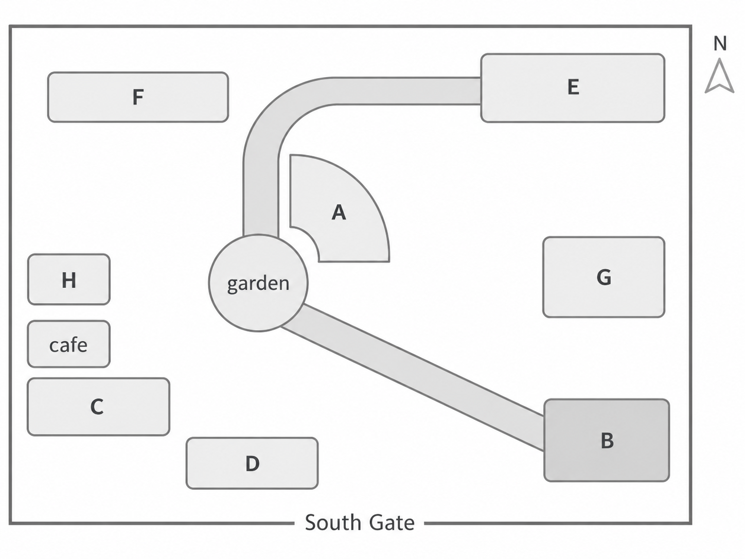
1. The campus garden is located near the centre of the campus and serves as a useful reference point.
2. The Student Service Unit provides administrative support, including course information, registration issues, and grades.
3. A large venue near the south gate hosts sports competitions, concerts, and regular student events.
4. The health centre provides medical checkups and consultations on different floors.
5. International students can receive assistance in a building that also hosts conferences and seminars.
6. The accommodation office has moved to a larger building beside the café.
7. Students must provide proof of payment and identification before receiving their accommodation keys.
8. Dormitory rooms are shared by two students, and residents must obtain permission to use basement facilities.
9. New security measures require students to use personal access codes and renew them through the online portal.
10. Students must switch off electronic devices after 11:30 p.m., or confiscated items will be kept until the end of the semester.
A. Students need to submit evidence that they have paid and show their identity cards before collecting their room keys.
B. The university has introduced a digital entry system to prevent theft, and students must regularly reactivate their codes online.
C. The central outdoor area is an important landmark that helps newcomers find their way around the university.
D. A building used for academic gatherings also contains an office offering guidance to students from overseas.
E. Failure to turn off electronic equipment by the designated nighttime deadline may result in its removal for the remainder of the term.
F. Students can obtain academic records, resolve enrolment problems, and receive general administrative assistance at a designated office.
G. A spacious facility close to the southern entrance accommodates thousands of spectators for entertainment and sporting activities.
H. The housing administration has relocated from its former premises to a more spacious office next to a place serving refreshments.
I. Medical services are divided between two levels, with examinations downstairs and professional advice upstairs.
J. Each bedroom houses two residents, while access to laundry equipment downstairs requires prior consultation with the building supervisor.
Part 3 - Field Trip Report Review
Exercise 1 – Definition Matching
Match each word or phrase with its correct definition (A – J).
Match each word or phrase with its correct definition (A – J).
A. A process of summarizing and analyzing existing academic or scientific materials
B. A platform or elevated structure designed for observation
C. A person who provides support in conducting scientific or academic studies
D. The scientific study of the Earth, including its composition, structure, and processes
E. Tools used to measure the acidity or alkalinity of a substance
F. Practical knowledge or skills gained through direct involvement in activities
G. Not necessary or no longer useful due to repetition or excess
H. Techniques employed to analyze and assess the properties of soil
I. A document used to systematically record gathered information
J. To write down or type spoken words or audio recordings
1. Geology [n] – địa chất học
2. Soil testing techniques [np] – các kỹ thuật kiểm tra đất
3. Viewing platform [np] – bệ quan sát
4. pH test kit [np] – bộ dụng cụ kiểm tra độ pH
5. Data collection sheet [np] – bảng thu thập dữ liệu
6. Literature review [np] – tổng quan tài liệu nghiên cứu
7. Real-world experiences [np] – những trải nghiệm thực tế
8. Redundant [a] – thừa thãi, không cần thiết
9. Transcribe [v] – ghi chép lại, chuyển lời nói thành văn bản
10. Research assistant [np] – trợ lý nghiên cứu
Exercise 2 – Sentence Completion
Complete the sentences using the words from the box below.
Complete the sentences using the words from the box below.
Vocabulary List:
Draft [n] – bản nháp
Survey site [np] – địa điểm khảo sát
Motivation [n] – động lực
Observations [n] – nhận xét
Detailed map [np] – bản đồ chi tiết
Satellite image [np] – hình ảnh vệ tinh
Suggestions for revision [np] – gợi ý để sửa đổi
Scientific reports [np] – báo cáo khoa học
Field trip [np] – chuyến đi thực địa
Broader perspective [np] – góc nhìn rộng hơn
1.
Before writing the final paper, students must submit a for feedback.
2.
The team visited the early in the morning to begin collecting data.
3.
Teachers hope that giving clear goals will increase students’ in their projects.
4.
Their were added to the report to highlight patterns noticed during the trip.
5.
The museum provided a showing every trail and landmark in the area.
6.
Researchers carefully analyzed the to identify changes in land use.
7.
She shared several to help improve the clarity of the presentation.
8.
Writing requires accuracy, structure, and evidence-based explanations.
9.
The helped the class understand the purpose of observing wildlife habitats.
10.
Adding regional data gave the study a much , making the conclusions stronger.
Exercise 3 – Paraphrasing
Match each original sentence (1 – 10) with its paraphrased equivalent (A – J).
Match each original sentence (1 – 10) with its paraphrased equivalent (A – J).
1. Natasha completed the field trip report to explore her academic interests and developed an interest in geology.
2. Mr. White thinks her report contains useful information but is poorly organised.
3. The tutor recommends using a scientific report template from the school website.
4. Natasha selected an unusual survey location because she wanted to investigate a site that had not been studied repeatedly.
5. She was interested in soil composition and used the trip to practise soil testing techniques.
6. Natasha combined her own findings with classmates’ data to gain a broader understanding of the site.
7. She created a detailed site map by adding her observations to a satellite image.
8. Natasha found the professional soil pH testing equipment difficult to operate.
9. The tutor advises reorganising the data collection sheet and expanding the literature review.
10. Interviews with local residents provided useful practical information, although collecting it was time-consuming.
A. The student struggled with a sophisticated instrument because its numerous controls were difficult to understand.
B. The teacher recommends a clearer arrangement of research variables and a wider range of academic references.
C. Natasha chose a less familiar location to avoid repeating investigations already carried out by other students.
D. Conversations with people living nearby offered valuable firsthand knowledge but required considerable time.
E. The investigation helped her identify a subject she wanted to pursue in her future studies.
F. She enhanced an existing aerial photograph by recording geographical features she could observe from a viewing point.
G. Although the report contains relevant details, its structure needs considerable improvement.
H. Combining information collected by other students with her own results helped her develop a more complete picture.
I. The tutor suggests following an established academic format specifically designed for scientific research reports.
J. Her interest in the characteristics of different soils gave her an opportunity to apply practical examination methods.
Part 4 - The Formation of Surtsey Island
Exercise 1 – Definition Matching
Match each word or phrase with its correct definition (A – J).
Match each word or phrase with its correct definition (A – J).
A. The sequence of changes in an ecosystem over time, from one community to another
B. Types of organisms, often microscopic, that are capable of causing diseases or other biological processes
C. The variety or richness of living conditions within a given area
D. The process by which a natural force, such as wind or water, wears down the Earth's surface
E. The physical features of the Earth's surface, such as mountains, valleys, and plains
F. A natural event where molten rock, ash, and gases are expelled from a volcano
G. The occurrence of waves and ocean currents in a given area
H. Plants that are the first to colonize barren or disturbed environments
I. Subatomic particles with high energy, such as protons or electrons
J. The use of radio waves to study distant objects, such as stars or planets
1. Volcanic eruptions [np] – những đợt phun trào núi lửa
2. Landform [n] – dạng địa hình, đặc điểm địa hình
3. Ecological succession [np] – sự diễn thế sinh thái
4. Pioneering plants [np] – các loài thực vật tiên phong
5. Bacterial species [np] – các loài vi khuẩn
6. Habitat abundance [np] – sự phong phú của môi trường sống
7. Energetic particles [np] – các hạt có năng lượng cao
8. Wave climate [np] – chế độ sóng biển, đặc điểm sóng biển
9. Rate of erosion [np] – tốc độ xói mòn
10. Radio observations [np] – các quan sát bằng sóng vô tuyến
Exercise 2 – Sentence Completion
Complete the sentences using the words from the box below.
Complete the sentences using the words from the box below.
Vocabulary List:
Violent explosions [np] – các vụ nổ dữ dội
Volcanic ash [np] – tro núi lửa
Fossilized remains [np] – hóa thạch còn lại
Sea surface [np] – bề mặt biển
Migrating birds [np] – chim di cư
Column of smoke [np] – cột khói
Shoreline [n] – đường bờ biển
Extreme weather [np] – thời tiết khắc nghiệt
Vegetation [n] – thảm thực vật
Human interference [np] – sự can thiệp của con người
1.
The sudden sent shockwaves across the valley and startled nearby residents.
2.
Layers of covered the ancient village after the eruption.
3.
Scientists found buried deep beneath the desert sands.
4.
Oil spills floating on the can severely harm marine life.
5.
Many species of follow seasonal routes across continents.
6.
The thick rising from the crater was visible for miles.
7.
Coastal erosion has reshaped the over the last decade.
8.
Heavy storms and have become more frequent due to climate change.
9.
Large areas of were destroyed during the wildfire.
10.
The ecosystem suffered greatly because of , such as construction and pollution.
Exercise 3 – Paraphrasing
Match each original sentence (1 – 10) with its paraphrased equivalent (A – J).
Match each original sentence (1 – 10) with its paraphrased equivalent (A – J).
1. Surtsey Island was formed by an underwater volcanic eruption near Iceland in 1963.
2. The eruption lasted for three and a half years and ended in June 1967.
3. Access to the island was restricted to scientists to allow natural ecological development without human interference.
4. Sea rocket was the first higher plant discovered on the island, while flies arrived shortly after its formation.
5. Scientists discovered extensive grass coverage and investigated the development of plant life on the island.
6. Migrating birds played an important role in bringing plant seeds to Surtsey.
7. The number of bacterial species increased rapidly at first before becoming relatively stable.
8. Scientists discovered a type of green vegetation called Marchantia that formed a thick carpet in a volcanic crater.
9. Fossils were discovered surprisingly soon after the island's formation, while volcanic activity continued to influence its development.
10. Severe storms and waves have gradually eroded Surtsey, although researchers estimate that it may survive for several centuries.
A. Researchers found an unusual green plant that spread densely across part of the island's largest crater.
B. Although the island is being worn away by powerful sea conditions, scientific predictions suggest that it could remain for hundreds of years.
C. A volcanic event beneath the ocean created a new landmass off Iceland's southern coast in the early 1960s.
D. Scientists were surprised to discover ancient remains on such a young island, which was still undergoing geological changes.
E. The earliest flowering plant appeared near the shore, while insects reached the new land through wind and flight.
F. The authorities limited visits to the island so that its natural development could be observed with minimal outside disturbance.
G. Birds travelling seasonally between different regions helped introduce new plant life by transporting seeds.
H. Microbial diversity expanded considerably during the island's early years before the number of species became more consistent.
I. The volcanic activity responsible for creating the island continued for several years before finally stopping in 1967.
J. Large areas of vegetation attracted scientific attention and provided opportunities to examine the island's growing plant diversity.