Part 1 - School Art Competition
Exercise 1 – Definition Matching
Match each word or phrase with its correct definition (A – J).
Match each word or phrase with its correct definition (A – J).
A. A public place where wild animals are kept for people to see
B. A document or ticket that can be exchanged for goods or services
C. A room or building for showing works of art
D. The main head of a school
E. A light meal with tea typically served in the late afternoon
F. An event where people compete to win a prize
G. Someone from the same school who is older or in a higher grade
H. A place where books, magazines, and other materials are available to borrow or read
I. A person from a nearby area who creates art
J. The main subject or idea of a piece of work or event
1. Principal [n] – hiệu trưởng
2. Competition [n] – cuộc thi
3. Theme [n] – chủ đề
4. Zoo [n] – sở thú
5. Senior students [np] – học sinh cấp trên / học sinh lớn tuổi hơn
6. Voucher [n] – phiếu mua hàng
7. Library [n] – thư viện
8. Local artist [np] – nghệ sĩ địa phương
9. Gallery [n] – phòng trưng bày
10. Afternoon tea [np] – tiệc trà chiều
Exercise 2 – Sentence Completion
Complete the sentences using the words from the box below.
Complete the sentences using the words from the box below.
Vocabulary List:
Organize [v] – tổ chức
Arrangements [n] – sự sắp xếp
Drawing [n] – tranh vẽ
Prize [n] – giải thưởng
Photograph [n] – bức ảnh
Submit [v] – nộp
Deadline [n] – hạn chót
Judge [v] – đánh giá
Exhibition [n] – triển lãm
Publish [v] – xuất bản
1.
You must your entry before the 15th of this month to be eligible.
2.
The best entries will be displayed at the local art .
3.
Each will be assessed based on creativity and technique.
4.
The for submitting your project has been extended by two days.
5.
We plan to a booklet containing all the selected works.
6.
The panel will the finalists based on originality.
7.
She spent weeks trying to the perfect photo for the contest.
8.
We need to the annual youth art competition by next month.
9.
The for first place includes a certificate and a cash award.
10.
The event manager handled all the for setting up the space.
Exercise 3 – Paraphrasing
Match each original sentence (1 – 10) with its paraphrased equivalent (A – J).
Match each original sentence (1 – 10) with its paraphrased equivalent (A – J).
1. The junior students will work with the theme of animals this year.
2. The prize for junior students will be zoo tickets.
3. The senior students will use the theme of "the city" for their artworks.
4. The seniors will submit photographs as their art form.
5. The winner among senior students will get a travel voucher as a prize.
6. All artwork entries must be submitted by May 18.
7. Artworks should be handed in at the library.
8. Rebecca Leigh will judge the competition again this year.
9. The artwork will be displayed at the Bridge Street Gallery.
10. The exhibition will happen in the late afternoon, followed by a dinner.
A. The entries will be shown at a historic venue on Bridge Street.
B. This year’s subject for the younger group will focus on animals.
C. Submissions are due by the 18th of May to allow time for judging and planning.
D. The students in the older group will use city life as the topic for their art.
E. The principal confirmed the same local artist, Rebecca Leigh, will evaluate the work again.
F. The artworks will need to be dropped off at the school library.
G. The late afternoon has been chosen for the art event so parents can attend after work, followed by a meal.
H. The senior students will produce photographic pieces for the contest.
I. Children in the junior group will be rewarded with tickets to the zoo instead of last year’s cinema passes.
J. A travel-related gift card will be given to the winning senior student.
Part 2 - Palm Island Day Trip
Exercise 1 – Definition Matching
Match each word or phrase with its correct definition (A – J).
Match each word or phrase with its correct definition (A – J).
A. The edge of the land where it meets the sea
B. A small, simple stand or structure used for selling goods or refreshments
C. A narrow path or track, often for walking
D. An area of land surrounded by water
E. A structure built to remember a person or event
F. Plants and trees that grow naturally in a region
G. A group of birds nesting together in one place
H. The regular rise and fall of the sea
I. Unusual shapes of natural stone, often formed by wind or water
J. The remains of a boat or ship that has sunk or been destroyed
1. Island [n] – hòn đảo
2. Coastline [n] – đường bờ biển
3. Tide [n] – thủy triều
4. Rock formations [np] – hình dạng đá tự nhiên
5. Trail [n] – đường mòn
6. Native bush [np] – rừng cây bản địa
7. Bird colony [np] – đàn chim làm tổ
8. Shipwreck / Old ship [np] – con tàu đắm / tàu cổ
9. Monument [n] – tượng đài
10. Kiosk [n] – quầy hàng nhỏ / quán nước nhỏ
Exercise 2 – Sentence Completion
Complete the sentences using the words from the box below.
Complete the sentences using the words from the box below.
Vocabulary List:
Tourist [n] – khách du lịch
Walk [n] – chuyến đi bộ
Mainland [n] – đất liền
Storm [n] – cơn bão
Restored [a] – được khôi phục
Packed lunch [np] – bữa trưa mang theo
Rare species [np] – loài quý hiếm
Regional park [np] – công viên khu vực
Path [n] – lối đi
Beach [n] – bãi biển
1.
The island is only accessible from the by ferry.
2.
Visitors are advised to stay on the marked to protect the environment.
3.
We spotted a of birds during our hike through the wetlands.
4.
The museum has been beautifully and now includes a new exhibition hall.
5.
Many come here to enjoy the stunning coastal scenery and marine life.
6.
Make sure to bring a since there are no restaurants in the area.
7.
A sudden forced all the hikers to return early from their trip.
8.
There’s a lovely along the cliffs with great views of the ocean.
9.
The is ideal for sunbathing, swimming, and collecting seashells.
10.
This is known for its diverse wildlife and hiking trails.
Exercise 3 – Paraphrasing
Match each original sentence (1 – 10) with its paraphrased equivalent (A – J).
Match each original sentence (1 – 10) with its paraphrased equivalent (A – J).
1. The Boundary Walk is ideal today because the low tide allows access to ancient coastal rock formations.
2. The Loop Track, although short, requires good fitness due to its steep terrain.
3. The Puriri Walk has some storm damage, but there's a rest area halfway through.
4. The North Head track goes through thick forest and is rich in birdlife.
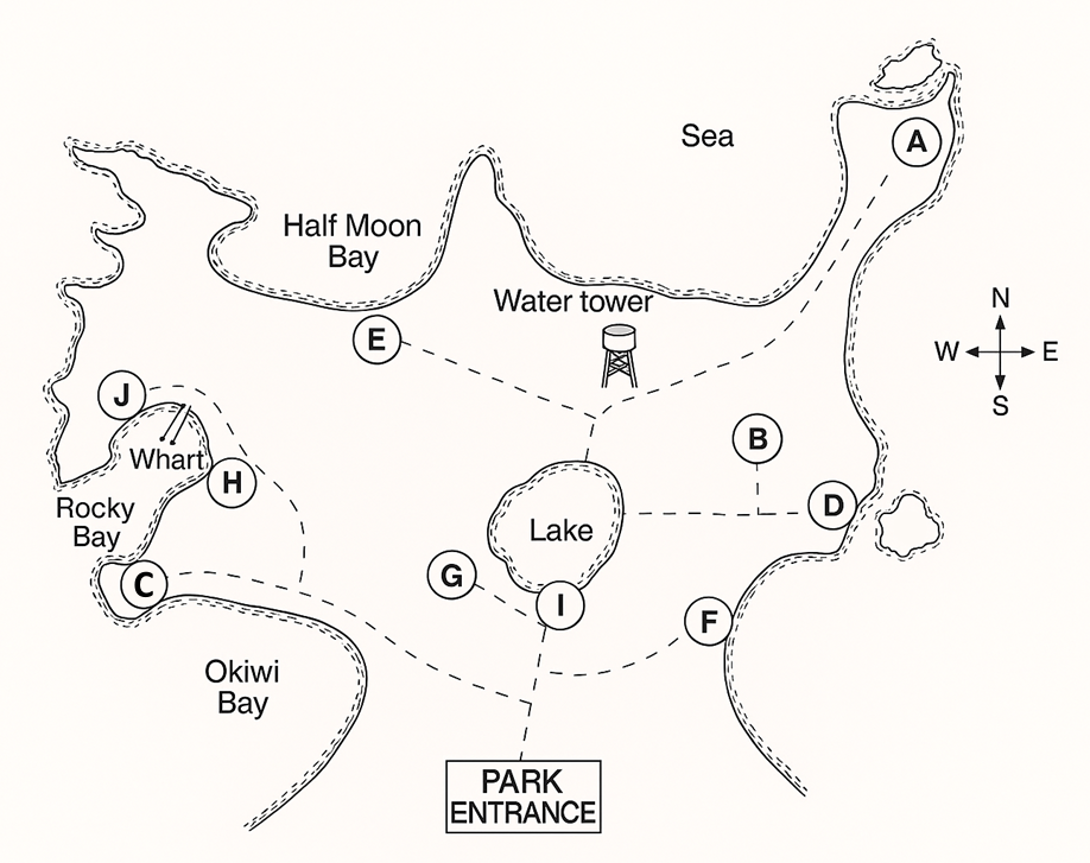
5. The bus will drop visitors at the park’s main entry point, found at the bottom of the map.
6. To visit the bird colony, follow the lake path and branch off toward the coast.
7. For safe swimming, take the right path before the lake to reach a sheltered beach.
8. The old ship can be reached by walking past the wharf near Rocky Bay.
9. The trail to Stony Batter requires turning off before reaching the water tower.
10. A kiosk offering drinks is located right next to the lake.
A. The Boundary Walk is perfect today for those interested in exploring ancient rocks exposed by the receding sea.
B. The walk to North Head doesn’t offer sea views, but it passes through native forest filled with birds.
C. You’ll be dropped off at the park entrance at the southern end of the map.
D. A short but strenuous hike, the Loop Track provides sweeping island and mainland views.
E. To get to the historic ship, you walk along the coast near Okiwi Bay and continue past the pier.
F. You’ll need to make a left before hitting the water tower to stay on the way to Stony Batter.
G. To reach a safe swimming spot, take the trail north and turn off before reaching the lake.
H. A table and chairs along the Puriri Walk offer a great spot to rest and eat, even though the path has some storm damage.
I. If you go up the path beside the lake and then head to the coast, you’ll find the bird colony.
J. The kiosk is by the lake and serves both hot and cold beverages.
Part 3 - Music Students Survey
Exercise 1 – Definition Matching
Match each word or phrase with its correct definition (A – J).
Match each word or phrase with its correct definition (A – J).
A. A group of singers performing together
B. The skill level someone has in a particular area
C. A shared agreement among a group of people
D. A style or category of music
E. A person’s education, experience, or history in a field
F. A small orchestra, typically with one player per part
G. The spirit, culture, or values of an organisation or group
H. The collection of pieces a performer or group is ready to perform
I. Something you aim to achieve
J. The ability to use specific techniques or methods expertly
1. Objective [n] – mục tiêu
2. Background [n] – nền tảng (kiến thức, kinh nghiệm)
3. Chamber orchestra [np] – dàn nhạc thính phòng
4. Choir [n] – dàn hợp xướng
5. Proficiency [n] – sự thành thạo
6. Consensus [n] – sự đồng thuận
7. Technical ability [np] – khả năng kỹ thuật
8. Repertoire [n] – kho tác phẩm biểu diễn
9. Genre [n] – thể loại (âm nhạc)
10. Ethos [n] – tinh thần, nét đặc trưng văn hóa
Exercise 2 – Sentence Completion
Complete the sentences using the words from the box below.
Complete the sentences using the words from the box below.
Vocabulary List:
Survey [n] – khảo sát
Attitude [n] – thái độ
Compose [v] – sáng tác (âm nhạc)
Audience [n] – khán giả
Venue [n] – địa điểm tổ chức
Dominant [a] – chiếm ưu thế
Practice [v] – luyện tập (âm nhạc)
Terrified of failing [adj phrase] – sợ thất bại
Master [v] – làm chủ, thành thạo
Assessed performance [np] – buổi biểu diễn được đánh giá
1.
He spent hours every day trying to the piano before his final recital.
2.
The jazz concert was held at an outdoor in the city centre.
3.
The music teacher conducted an to understand students' preferences in genres.
4.
She was and almost dropped out of the music competition.
5.
This piece was by a young musician who won several awards for her work.
6.
Students were given an as part of their end-of-term evaluation.
7.
His towards classical music changed after he attended a live orchestra.
8.
The pop genre remains in the charts despite the rise of alternative styles.
9.
It’s important to regularly if you want to improve your guitar skills.
10.
The applauded enthusiastically at the end of the performance.
Exercise 3 – Paraphrasing
Match each original sentence (1 – 10) with its paraphrased equivalent (A – J).
Match each original sentence (1 – 10) with its paraphrased equivalent (A – J).
1. The study focused on music students’ perspectives on performing.
2. Before university, nearly everyone had performed publicly in small or large venues.
3. Many students had composed music during their course, even if they hadn’t done so before.
4. Almost all students had some access to a piano, though not all had formal training.
5. Fear of failure is a stronger motivator to practise than perfectionism.
6. While some preferred solitary practice to address weak spots, most agreed that mastering tough pieces was the most rewarding.
7. Most students tried to memorise their performance pieces to avoid getting lost during nervous moments.
8. A fair number of students listened to others playing the same piece for preparation.
9. Choosing performance pieces was not simple for many; various factors made it time-consuming.
10. Working with others who play the same instrument was seen as beneficial rather than threatening.
A. Music students were surveyed to find out how they feel about giving performances.
B. One thing nearly everyone had done before starting university was take part in musical groups in front of live audiences.
C. Composing music was new to many at the start, but now most had done it during the course.
D. Most participants in the study had played piano informally at some point, though formal lessons weren't universal.
E. Students said fear of messing up pushed them to practice more than a desire for flawlessness.
F. Although some liked practising alone to focus on their flaws, the majority valued the achievement of mastering complex pieces.
G. Memorising pieces is a common strategy to prevent mistakes when nerves set in.
H. Quite a few respondents said listening to recordings or peers helped in learning their pieces.
I. Despite assumptions, selecting what to perform involved many considerations and took a long time for most.
J. Playing with others on the same instrument was widely seen as useful and encouraging, not frightening.
Part 4 - Gastropods
Exercise 1 – Definition Matching
Match each word or phrase with its correct definition (A – J).
Match each word or phrase with its correct definition (A – J).
A. Any chemical used in agriculture, such as pesticides or fertilisers
B. An organ in snails/slugs used to scrape or cut food
C. Creatures without a backbone
D. A soft-bodied animal, usually with a shell, like a snail
E. A structure that secretes the shell and covers internal organs in molluscs
F. Thin, raised lines or ridges found on a shell’s surface
G. Living on a diet consisting mainly of other animals
H. Moisture or slight wetness in the environment
I. The preserved parts of an organism found in rock
J. A slimy layer secreted by some animals to help movement or retain moisture
1. Gastropod [n] – động vật chân bụng
2. Invertebrate [n] – động vật không xương sống
3. Fossilized remains [np] – phần xương/bộ phận hóa thạch
4. Radula [n] – lưỡi mài (cơ quan ăn của ốc/sên)
5. Rib [n] – gờ (trên vỏ ốc)
6. Carnivorous [a] – ăn thịt
7. Mantle [n] – lớp áo (một phần cơ thể ốc/sên)
8. Dampness [n] – độ ẩm
9. Mucus film [np] – màng chất nhầy
10. Agrochemical [n] – hóa chất nông nghiệp
Exercise 2 – Sentence Completion
Complete the sentences using the words from the box below.
Complete the sentences using the words from the box below.
Vocabulary List:
Backbone [n] – xương sống
Muscular foot [np] – chân cơ bắp (dùng để di chuyển)
Mucus [n] – chất nhầy
Shell [n] – vỏ
Coil [v] – xoắn, cuộn
Spine [n] – gai
Rotting plants [np] – cây mục rữa
Prey on [vp] – săn mồi
Predator [n] – động vật săn mồi
Extinction [n] – sự tuyệt chủng
1.
The snail’s body is protected by a hard that it can retreat into when threatened.
2.
Without a , invertebrates like snails have greater flexibility in movement.
3.
The hedgehog uses its to defend itself from predators.
4.
Many sea creatures use to help them move along the ocean floor.
5.
Snakes often around their prey before swallowing it whole.
6.
Frogs secrete from their skin to keep it moist and slippery.
7.
Slugs feed on and decaying organic matter in gardens.
8.
The owl is a well-known that hunts small mammals at night.
9.
Cats are known to birds and mice in residential areas.
10.
Pollution and habitat destruction are pushing several amphibians towards .
Exercise 3 – Paraphrasing
Match each original sentence (1 – 10) with its paraphrased equivalent (A – J).
Match each original sentence (1 – 10) with its paraphrased equivalent (A – J).
1. Gastropods are primitive invertebrates including snails and slugs.
2. Their body chemistry reveals that they originated in marine environments.
3. Snails move with the help of a single muscle and leave behind a trail of mucus.
4. Shells come in many sizes, shapes, and textures, and some even have hair.
5. While some gastropods eat plants, most consume decaying matter or other animals.
6. Gastropods have many natural enemies, including birds, frogs, and certain flies.
7. Snails were brought to Britain by the Romans and are still consumed by people today.
8. Some gastropods, like the glutinous snail, use unique defenses to avoid being eaten.
9. Most gastropods prefer moist, shady places, and suffer in dry or extreme temperatures.
10. Because they are sensitive to pollution, gastropods are a useful sign of ecosystem health.
A. Many snail shells differ in colour, pattern, coiling direction, and even surface features like hairs or spines.
B. Because their bodily minerals resemble those in seawater, scientists believe gastropods originally lived in the ocean.
C. These ancient creatures are soft-bodied, lack backbones, and include both shelled and shell-less varieties.
D. These animals are environmentally sensitive, so they can be used to assess levels of pollution.
E. Their mucus-covered foot helps them travel and is what leaves the familiar sticky path.
F. A few species feed on plants, but most are detritivores, fungi-eaters, or even predators like the shield slug.
G. Creatures like birds, amphibians, and even insects commonly hunt gastropods.
H. Humans have eaten snails since Roman times, and wild harvesting has even led to the decline of one species.
I. To defend themselves, some gastropods have adapted by disguising or transforming their appearance.
J. Damp, shaded environments are ideal for them, and they often suffer when it’s too dry or the temperature is extreme.